The honest DeepSeek V4.1 Flash alternative (2026) for creators who want a finished content stack, not a raw text API
DeepSeek V4.1 Flash is a cheap new multimodal LLM API. Kompozy is a content engine that generates media and publishes across nine platforms. Honest comparison.
Published 2026-09-09 · Updated
Short answer
DeepSeek V4.1 Flash is a cheap multimodal language model on DeepSeek's API, from $0.15 per million input tokens off-peak. It reads images and writes text, but it makes no images or video and publishes nothing. Use it if you're building your own app. Use Kompozy if you want finished posts in your brand voice, published to 4 platforms on Starter ($199/mo) or 9 on Pro ($499/mo).
Key takeaways
- DeepSeek V4.1 Flash went live on September 10, 2026; build V4.1-Flash-1017 followed on October 17.
- API pricing starts at $0.15 per million input tokens and $0.60 per million output tokens off-peak.
- It returns text only. It renders no images or video, adds no captions, and publishes to no platform.
- Kompozy generates video, images, carousels, blogs and newsletters, then publishes to 9 platforms.
- A common setup: draft cheaply on DeepSeek, then finish and publish in Kompozy.
If you searched "DeepSeek V4.1 Flash alternative," start with what it actually is, because it's a genuinely interesting model and this page won't pretend otherwise. V4.1 Flash is a new, re-architected build of DeepSeek's fast Flash tier that natively reads images alongside text, went live on DeepSeek's API on September 10, 2026 under the model name deepseek-flash, and DeepSeek began serving an updated build, V4.1-Flash-1017, on October 17. It's cheap (from $0.15 per million input tokens off-peak), and DeepSeek says tests put it ahead of the larger V4-Pro on performance, cost, and speed. For cheap, image-aware text generation from code, it's a strong option.
But two things about its shape are the reason to read on. First, it moves fast. DeepSeek shipped two V4.1 Flash builds in about five weeks and retired the older Flash models, so anything you build on it has to keep up with the changelog.
Second, and true of any version: V4.1 Flash returns text. It renders no image, cuts no clip, records no avatar, applies no brand template, schedules nothing, and publishes to no platform. So most people typing "DeepSeek V4.1 Flash alternative" split into two groups. The first wants a raw multimodal LLM to call from code — in which case DeepSeek is the right answer and you may not need an alternative at all.
The second assumed a cheap frontier model would get them to published content, then hit the reality that a draft (or an extracted screenshot) is a long way from a captioned Reel, a branded carousel, and a scheduled week of posts.
I run Kompozy, so this is a build-vs-buy comparison, not an apples-to-apples one. Kompozy is not a raw model and doesn't sell one; it's the production-and-distribution engine that turns text into finished, on-brand content and ships it across nine destinations — and it's a finished product you log into, not a model you wire up. This page is for the second group. Everything below reflects the date at the bottom; confirm DeepSeek's current specs and pricing in its changelog, since the model changes often.
What is DeepSeek V4.1 Flash?
DeepSeek V4.1 Flash is a general-purpose multimodal language model. You call it through DeepSeek's API on the unchanged base URL with the model name deepseek-flash, which DeepSeek now serves with the V4.1-Flash-1017 build, a 1M-token context window, and a 2,500-request concurrency limit. It reads images (describe a picture, OCR a screenshot, analyze a chart) and handles ordinary text tasks — drafting, summarizing, extraction, reasoning — and DeepSeek says it does so faster and cheaper than the previous Flash while beating the larger V4-Pro. DeepSeek's September 10 announcement also said it is phasing out V4-Pro. What it does not do, and does not claim to: generate images, video, or audio; add captions or reframe a clip; render brand-styled carousels or graphics; govern a consistent brand voice across a team; schedule; or publish to any platform. It produces text, and stops there.
Why do people look for a DeepSeek V4.1 Flash alternative?
You'd look past DeepSeek V4.1 Flash the moment your goal shifts from "generate or read text" to "publish content" — or the moment you need something stable to build on. A frontier model in an API is raw material: to get from a draft (or an analyzed image) to a live post you'd bolt on image and video generation (the model makes neither), a captioning and reframing step, a designer for carousels and quote cards, a brand-voice layer, and a scheduler with integrations for each platform — then build and maintain that pipeline. For a developer that's a project; for a marketer or solo creator it's a non-starter. The model also moves fast: DeepSeek retired the older Flash models and shipped a new V4.1 build within about five weeks, so a pipeline built on it needs upkeep. And there's no brand governance — V4.1 Flash follows the prompt, with no persistent Persona Brief, banned-word list, or per-workspace identity. Kompozy is the alternative when you want that entire downstream — media generation, brand consistency, scheduling, and multi-platform publishing — handled for you in one product, so the model's cheap text becomes finished posts without an engineering project.
How does DeepSeek V4.1 Flash compare with Kompozy feature by feature?
| Feature | DeepSeek V4.1 Flash | Kompozy | Note |
|---|---|---|---|
| Native multimodal input (reads images) | Yes | Partial | V4.1 Flash reads images natively; Kompozy consumes visual sources through its own generation flows, not as a raw vision API. |
| Frontier-class text generation | Yes | Yes (via Claude & OpenAI) | V4.1 Flash is the model itself; Kompozy runs copy generation on managed Claude and OpenAI models. |
| Raw API / per-token pricing | Yes | No (credit-based app) | DeepSeek bills per token at V4-Flash rates; Kompozy is a metered content app, not an API. |
| Finished app, no pipeline to maintain | No (raw API) | Yes | DeepSeek ships new builds and retires old ones on its own schedule; Kompozy is an app you log into, with no model versions to track. |
| Image / video / avatar generation | No | Yes | V4.1 Flash outputs text only despite reading images; Kompozy renders persona/avatar video, images, carousels, and quote cards. |
| Captioning, clipping, reframing | No | Yes | Kompozy burns in captions, cuts vertical shorts, and reframes to 9:16 / 1:1 / 16:9. |
| Brand-voice governance | Partial (prompt only) | Yes (Persona Brief) | DeepSeek follows the prompt; Kompozy holds a persistent brand voice, banned words, and identity per workspace. |
| Multi-platform publishing | No | Yes (9 destinations) | DeepSeek publishes nothing; Kompozy fans posts to eight social platforms plus blog and email. |
| Scheduling + autopilot | No | Yes | Kompozy has a per-post review pipeline and autopilot; a raw model has no scheduler. |
| Ready to use without engineering | No (build a pipeline) | Yes | Kompozy is log-in-and-go; turning V4.1 Flash into a content stack is a build project. |
How much does DeepSeek V4.1 Flash cost compared with Kompozy?
| Tier | DeepSeek V4.1 Flash plan | DeepSeek V4.1 Flash price | Kompozy plan | Kompozy price |
|---|---|---|---|---|
| Entry | DeepSeek V4.1 Flash API (deepseek-flash) | $0.15/$0.30 per M input tokens (cache miss, off-peak/peak), $0.60/$1.20 per M output, usage-based | Kompozy Starter | $199/mo (5,500 credits) |
| Mid | DeepSeek V4.1 Flash (heavy usage) | Usage-based, scales with tokens + images | Kompozy Pro | $499/mo (18,000 credits) |
| Top | V4.1 Flash API + your own content stack | Model tokens + cost of generation/design/scheduling tools | Kompozy Enterprise | Contact Sales |
What does DeepSeek V4.1 Flash do well?
- Native multimodality — reads images alongside text in the mainline model, no separate vision endpoint.
- Cheap: $0.15 per million input tokens off-peak ($0.30 at peak) on a cache miss.
- DeepSeek says tests by multiple parties put it ahead of the larger V4-Pro on performance, cost, and speed.
- Same base URL and OpenAI/Anthropic-compatible interfaces, so it drops into existing DeepSeek code.
- If the V4-Pro claim holds, it makes cheap, image-aware drafting the new baseline for a lot of pipelines.
Where does DeepSeek V4.1 Flash fall short for content work?
- It moves fast: two builds in about five weeks, and the older Flash models it replaced are retired.
- The headline benchmarks are DeepSeek's own and not independently verified yet.
- Text only — despite reading images, it generates no images, video, or audio, so it cannot produce a visual post by itself.
- No captioning, clipping, reframing, or design layer; a drafted or extracted idea still needs all of that added.
- No persistent brand-voice governance — it follows the prompt, with no Persona Brief or banned-word system.
- No scheduling and no publishing; it connects to no platform out of the box.
When should you pick DeepSeek V4.1 Flash?
- You want a cheap multimodal LLM to call from code. V4.1 Flash is an API-first model for drafting, extraction, and image reading — ideal if you are building your own app or agent.
- Your task is pure text, reasoning, or image understanding at scale. For high-volume drafting, summarizing, OCR, or chart analysis, a cheap frontier model is exactly the right tool.
- You already run on DeepSeek and want the latest Flash. Same base URL and compatible interfaces make adopting it a low-friction change; the old deepseek-v4-flash name already routes to it.
When should you pick Kompozy instead of DeepSeek V4.1 Flash?
- Your goal is published content, not API access. Kompozy generates the media and publishes it across nine destinations — the model layer is handled for you.
- You want a finished product, not a model to keep up with. Kompozy is a production tool you can build a recurring workflow on, without tracking model builds and retirements.
- You need visuals, not just words. Persona/avatar video, carousels, quote cards, and infographics — V4.1 Flash renders none of it; Kompozy renders all of it.
- You want on-brand output without prompt-babysitting. The Persona Brief governs voice, banned phrases, and identity per workspace so every asset stays consistent.
Should you build on DeepSeek V4.1 Flash or buy Kompozy?
The honest pitch is a build-vs-buy one, because DeepSeek V4.1 Flash and Kompozy are not competing products — one is a component, the other is the finished stack. V4.1 Flash is a superb answer to a narrow question: "I want cheap, capable, image-aware text generation from an API." If that's the whole of your problem, call it and don't pay for a content SaaS.
But text from an API is the first floor of a content operation, not the building. To get from a draft or an extracted screenshot to a published Reel, carousel, or newsletter you'd add image and video generation (V4.1 Flash makes neither), brand styling and captions, a scheduler, and integrations for nine platforms — then build and maintain all of it while the model underneath keeps changing.
Kompozy is that whole layer, already built and managed: content formats across five buckets (video, image, text, blog, and newsletter), one brand voice held by a Persona Brief, HyperFrames for pixel-exact styling, and publishing to nine destinations on a schedule and on autopilot.
The cleanest way to decide: if you most want to own and control the model, use V4.1 Flash. If you most want to produce and ship content on something you can rely on, use Kompozy — and if you want both, draft and extract cheaply on V4.1 Flash, then let Kompozy turn that output into finished, scheduled posts. Note Kompozy's own copy generation runs on Claude and OpenAI, so DeepSeek is your upstream drafting choice and Kompozy is the downstream engine. Start on Kompozy Starter at $199/mo (5,500 credits) to test the production half against your model stack.
What does this look like in Kompozy?
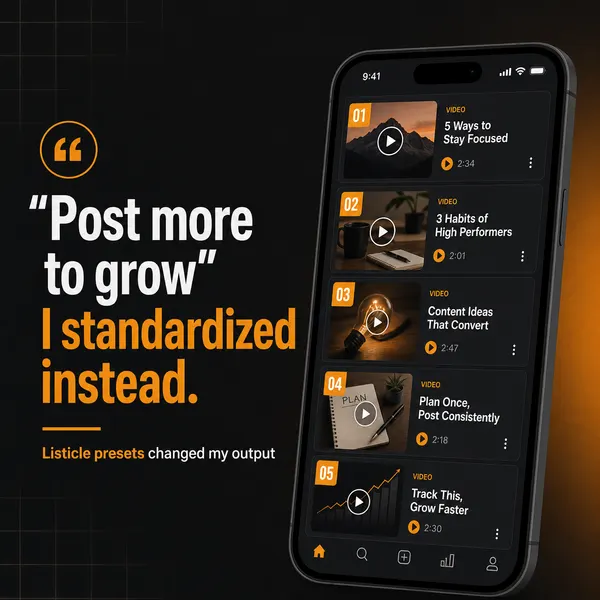
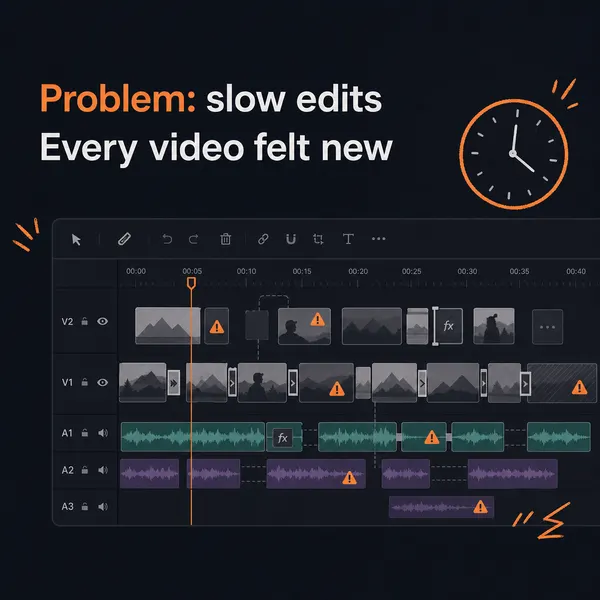
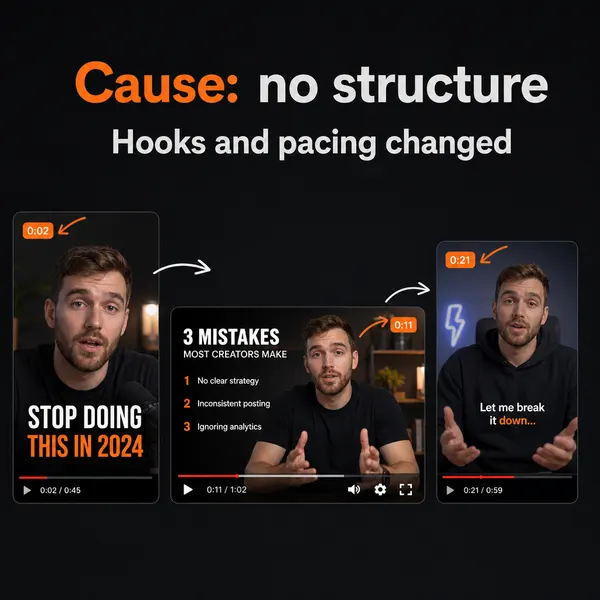
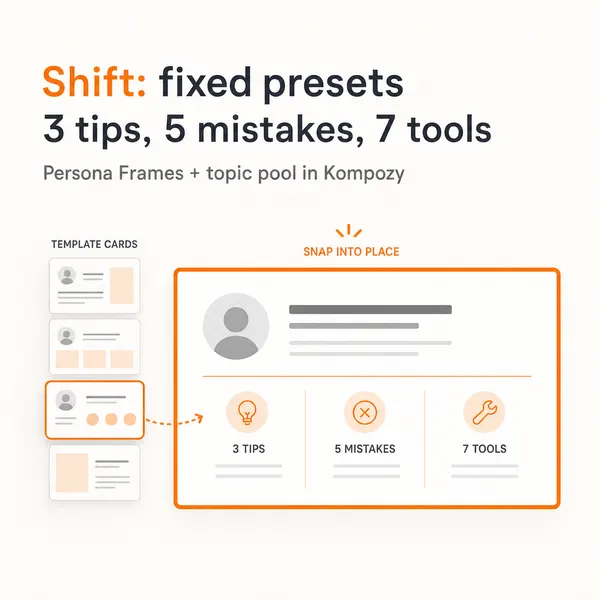
A five-slide carousel generated in the Kompozy workspace. A text model like V4.1 Flash cannot render this kind of visual post on its own.

Who is this for, and who should skip it?
Best for:
- Marketers and solo creators who want published posts, not an API to build on
- Teams that need video, carousels and images, which V4.1 Flash cannot render
- Brands that want one voice held across every asset by a Persona Brief
Not ideal for:
- Developers building their own app or agent who just need cheap text and image understanding (use DeepSeek)
- High-volume drafting, summarizing or OCR jobs where per-token cost is the main concern
- Teams already on DeepSeek that only want the newest Flash model
Frequently asked questions
Is DeepSeek V4.1 Flash a competitor to Kompozy?
Not really — they sit at different layers. V4.1 Flash is a language model you call through an API; Kompozy is a content generation and publishing engine you log into. DeepSeek returns text; Kompozy turns text into finished, scheduled posts across platforms and also generates the video, images, and carousels a raw model can't. For most content workflows they are complementary, not competing.
Can I use DeepSeek V4.1 Flash to create and publish social media content?
It can draft copy and read your images cheaply, but it cannot generate images or video, design posts, add captions, or publish anything — its output is text. To turn a V4.1 Flash draft into published content you either build that pipeline yourself or use a content engine like Kompozy that generates the media and publishes to nine destinations.
Is DeepSeek V4.1 Flash still in beta?
No. DeepSeek moved V4.1 Flash onto its main API on September 10, 2026 under the model name deepseek-flash, and on October 17, 2026 it started serving an updated build, V4.1-Flash-1017. The older V4-Flash models are retired, and their legacy names now route to the new model.
How much does DeepSeek V4.1 Flash cost versus Kompozy?
V4.1 Flash is usage-based: $0.15 per million input tokens (cache miss) and $0.60 per million output tokens off-peak, doubling to $0.30/$1.20 at peak hours. Kompozy is a managed subscription starting at $199/mo (5,500 credits) for Starter and $499/mo (18,000 credits) for Pro, with no per-token metering and nothing to build.
Can I use DeepSeek V4.1 Flash and Kompozy together?
Yes, and it is a natural setup: draft and extract cheaply on V4.1 Flash — hooks, scripts, outlines, or text pulled from screenshots and charts — then bring that into Kompozy to generate the avatar video, images, and carousels and publish across platforms. DeepSeek owns the low-cost drafting; Kompozy owns the media and the publish. (Kompozy's built-in copy models are Claude and OpenAI, so DeepSeek is an upstream choice, not a plug-in.)
How do we know this?
On 2026-10-23 we checked every DeepSeek figure on this page against DeepSeek's API pricing page and its September 10 and October 17 release notes. We rewrote the beta-era claims, which were out of date. Kompozy plan details come from kompozy.io/pricing.
Sources
- DeepSeek API Docs — Models & Pricing (read 2026-10-23)
- DeepSeek API Docs — DeepSeek-V4.1-Flash: Smarter, Faster, More Efficient (2026-09-10) (read 2026-10-23)
- DeepSeek API Docs — DeepSeek-V4.1-Flash-1017 Release (2026-10-17) (read 2026-10-23)
- Kompozy — Pricing (read 2026-10-23)
- Kompozy — Home (read 2026-10-23)
- AI Content Repurposing — The complete methodology for turning one source into 25-35 pieces of native-format content across every platform — without producing AI slop.
- Autonomous Content Creation — Most "autonomous" AI content is slop.
- AI Brand Voice & Persona — Without a Persona Brief, every AI output averages to the LLM default voice.