AI citations (2026): how answer engines select, cite, and recommend the sources behind an answer
An AI citation is the source an answer engine attaches to a claim in a generated answer — the little link under a sentence in ChatGPT, Perplexity, Gemini, or Google's AI Overviews that says where that fact came from. Being cited is the new distribution: it is how a source gets read, quoted, and eventually recommended when the engine, not a ten-blue-links page, is the thing the searcher talks to. This guide explains the mechanism rather than the tactics — what an AI citation actually is, the pipeline a source moves through to earn one (retrieval, passage-level selection, grounding, attribution), why citing a source and recommending a brand are two different jobs the same engine performs, which surfaces engines reach for most often, and what actually makes a passage citable. The honest throughline is that citation is downstream of publication: an engine can only cite a clear, specific passage that already exists on a surface it retrieves from, which turns AI visibility into a content-production problem long before it is an optimization one.
Published 2026-09-10 · Updated
Short answer
An AI citation is the source an answer engine attaches to a claim, such as the link under a sentence in ChatGPT, Perplexity, Gemini or Google's AI Overviews. Engines retrieve passages that match the query, ground the answer in the most relevant and trusted ones, and credit each claim. Profound's study of 680 million citations found Wikipedia leading ChatGPT and Reddit leading Perplexity, so presence across several surfaces matters.
Key takeaways
- A citation is evidence for a claim; a recommendation names you as an option. They need different content.
- The pipeline runs retrieval, passage selection, grounding and attribution.
- Profound found Wikipedia led ChatGPT citations and Reddit led Perplexity and AI Overviews.
- Ranking on Google helps, but pages off page one still get cited.
- Write self-contained, specific passages that make sense when lifted out of the page.
What is an AI citation?
An AI citation is the source an answer engine shows to back up a claim in its answer — the small link under a sentence in ChatGPT, Perplexity, Gemini, or Google's AI Overviews that says, in effect, "this is where that came from." It matters because the citation is the new unit of distribution. When the engine, not a page of ten blue links, is the thing the searcher talks to, being cited is how your content gets read at all, how it gets quoted, and — over enough answers — how your brand becomes the one the engine recommends. If you are not in the citations, you are not in the answer, and increasingly the answer is the whole session.
This guide is about the mechanism, not a tactics list. The subject is how AI search systems actually select, cite, and recommend source content: what a citation is at a technical level, the pipeline a source travels to earn one, why citing a source and recommending a brand are separate jobs, which surfaces engines reach for, and what makes a passage citable in the first place. The honest throughline runs under all of it — an engine can only cite a passage that already exists on a surface it retrieves from, so citation is downstream of publication. That is why AI visibility turns into a content-production problem long before it is an optimization one.
How is an AI citation different from a search ranking?
A search ranking was a competitive verdict: ten pages sorted by which one the engine judged most deserving of the click. A citation is not competitive in that sense. It is evidential — the engine has drafted an answer and is pointing to the retrieved sources that support each part of it, so the user can trust and verify the claim. Multiple sources can be cited for one answer, none of them is "winning" over the others, and a cited page is not necessarily the best page on the topic; it is the one that carried the specific, retrievable passage the engine needed.
This distinction has a practical edge. Because a citation is grounding rather than reward, the engine is looking for a passage it can stand behind, not a page that checks optimization boxes. A confidently written sentence with a concrete, checkable fact is more citable than a longer, hedged page that says nothing an engine could attach to a claim. The whole game shifts from "rank the page" to "be the source of the sentence," and the two do not always coincide.
How does a source earn an AI citation?
A citation is the last step of a pipeline that runs in a second or two. Understanding the stages tells you where a source can win or lose a citation, because each stage filters what the next one can even see.
1. Retrieval and query fan-out
Answer engines are built on retrieval-augmented generation: rather than answering purely from the model's memory, the system retrieves live documents and grounds the answer in them. To do that well it rarely searches the raw query once. It decomposes the question into several sub-queries and runs them in parallel — a behavior Google calls query fan-out — then gathers candidate passages from across those searches. A source that is invisible to retrieval (blocked from crawling, rendered only in client-side script, or simply not published on a surface the engine indexes) never enters the candidate pool, and nothing downstream can rescue it.
2. Passage-level selection
Selection happens at the passage level, not the page level. The engine is matching the user's question and its own drafting answer against chunks of text, looking for tight semantic alignment — passages whose wording and framing map onto the query and the shape of the answer being written. This is why a single strong section can earn a citation for a page that is otherwise unremarkable, and why a broad, unfocused page can be passed over even when it "covers" the topic. The unit that gets cited is a passage; the page is just where it lives.
3. Grounding and drafting
The model drafts the answer against the selected passages, using them to keep its claims tied to retrievable evidence. In practice the ordering of "answer" and "source" is not always clean — analyses have found that a meaningful share of citations are post-rationalized, where the model composes a claim and then attaches the retrieved source that best supports it, rather than reading the source first and paraphrasing. Either way the requirement on your content is the same: the passage has to state, clearly and specifically, the claim the engine is trying to support.
4. Attribution
Finally the engine attaches the citation — the visible link to the source behind a claim. Which source gets the credit is decided by fit and trust: the passage that most directly and defensibly supports the sentence, from a domain the engine treats as credible on that topic. Two sources may say the same thing; the one that says it more specifically, more self-containedly, and from a more trusted place is the one that gets named.
What is the difference between being cited and being recommended by AI?
It is easy to blur "cited by AI" and "recommended by AI," but they are distinct outcomes the same engine produces, and confusing them leads to the wrong content. A citation is evidential: the engine quotes a source to support a factual claim, and the cited page might be a study, a definition, a forum thread, or a news article with no commercial stake at all. A recommendation is a verdict: in response to a "which tool should I use" or "best X for Y" query, the engine names specific brands as the answer, drawing on its synthesized understanding of the category rather than a single retrieved passage. This split is covered in depth in AI answer visibility and citations and how to get your brand recommended by AI.
The consequence is that you can be heavily cited and never recommended — a widely quoted definitional page earns citations while the engine recommends a competitor as the product — and you can be recommended without a single citation to your own site, because the engine assembled its verdict from third-party comparisons, reviews, and community discussion about you. Winning both requires overlapping but different content: citable evidential passages for the factual queries, and a consistent, corroborated presence across comparisons and community for the decision queries. Treating them as one job is why brands over-invest in one and stay invisible in the other.
Which sources do AI answer engines cite most?
Because retrieval favors passages an engine can trust and quote, a consistent pattern shows up in Profound's analysis of 680 million citations from August 2024 to June 2025: community, encyclopedic, and video sources sit near the top. Wikipedia led ChatGPT's citations, Reddit led Perplexity and Google's AI Overviews, and YouTube ranked high in AI Overviews. The skew differs by engine. Perplexity leans hard on Reddit and recent community discussion; ChatGPT leans encyclopedic and toward established media; Google's AI answers pull video and its own indexed results more than the standalone engines do. The overlap between what any two engines cite is smaller than most people assume, which is why a single optimized page is a fragile bet.
The strategic reading is not "go post on Reddit." It is that citations are distributed across surfaces and formats, so presence on more than one of them is what makes you retrievable for more of the queries in a topic. A brand that exists only as a website is competing for a narrow slice of the citation pool; a brand that also shows up in video, in professional-network posts, and in genuine community discussion is retrievable in far more of the answers being generated. Which surfaces matter for your topic is worth auditing directly — the method is in how to run a GEO content audit.
Does traditional ranking still matter?
Yes, but not the way it used to, and not enough on its own. Ranking well on Google remains one of the stronger predictors of being cited, especially on Google's own AI surfaces, because AI Overviews and AI Mode draw on the same index — a page Google already trusts is a page its AI answers can reach for. But pages that do not rank on page one of Google still get cited, because the standalone engines select by semantic passage fit and source trust rather than by ranking position. The takeaway is to treat a strong ranked page as one input to citability, not the whole of it, and to stop assuming your SEO winners are automatically your AI winners.
What makes a passage citable?
Every stage of the pipeline points at the same content properties. A citable passage is self-contained: it makes complete sense lifted out of the page, which means it restates its subject instead of leaning on "it," "this," or "as noted above" — anything that breaks when the passage is extracted alone. It is specific: it carries a concrete, checkable fact — a number, a named process, a date, a defined term — because an engine grounding a claim reaches for the passage that states something it can attribute, not the one that sounds confident while saying nothing. It leads with the answer: a direct response up front, with supporting depth beneath, mirrors the shape an engine is trying to lift.
It is also entity-clear and consistent. Engines increasingly reason over entities — which brand is a vendor, which source discusses the category — so naming your subject plainly and describing it the same way across your site and profiles helps the engine build a confident, corroborated picture rather than a hedged one. And it has to be machine-readable: content buried in an accordion, a tab, or client-side script an engine never executes cannot be cited no matter how good it is. The structured-data layer that reinforces this is covered in schema markup for AI citations, and the broader craft in AI citation optimization. Underneath all of it sits the discipline of shaping content so engines can retrieve and quote it — generative engine optimization.
Where does Kompozy fit in earning AI citations?
Follow the pipeline to its root and the constraint is blunt: an engine can only cite a passage that already exists on a surface it retrieves from. Since citations are distributed across articles, video, community, and professional feeds — and no single one dominates every engine — being citable for a topic means being present, in the right shape, on several surfaces at once. That is not an optimization task; it is a production task, and it is the specific wall most teams hit. Knowing you need a citable article, a video, and a set of social posts is easy; producing all of them, on-brand, at a cadence, for every topic you want to win, is where the strategy stalls. This is the gap Kompozy is built to close.
Kompozy is an AI content generation and multi-platform publishing engine, not a rank tracker or a citation monitor — and that is exactly the right tool for a problem that is fundamentally about throughput. From one idea or source it generates the range of formats the citation pool actually draws from: blog articles and text posts for the evidential, self-contained passages that get quoted; brand-exact carousels, quote graphics, and infographics for the visual surfaces; and, because video is one of the most-cited formats, talking-head Persona Shorts, clipped verticals, and avatar video for YouTube and the social feeds. Every output descends from one Persona Brief that pins voice and terminology, which is also what keeps your entity described consistently across surfaces — the corroboration engines reward when they decide whether to trust a claim about you.
The publishing side is where presence actually happens. Autopilot fans that set across the eight primary social platforms plus blog and email on a steady cadence, behind a per-post review gate so nothing ships unread — so the multi-surface footprint that makes you retrievable gets built and maintained rather than attempted once and abandoned. Keep the boundary honest: Kompozy does not post to Reddit for you, it does not write your Wikipedia entry, and it cannot make an engine cite you — that is earned by the quality and specificity of the passage and by third-party discussion you do not control. What it removes is the reason most brands are citable on one surface and invisible on the rest: the throughput ceiling between deciding what to publish and actually publishing it everywhere the answer engines look. A solo operator building citable presence on one brand fits Starter ($199/mo, 5,500 credits); a team producing a corroborating, multi-surface cadence fits Pro ($499/mo, 18,000 credits); Enterprise is available through Contact Sales for agencies running many brands. For the measurement side of the loop, pair this with AI search performance reporting in Search Console.
How do answer engines decide what to cite?
An AI citation is the engine showing its work — the source it attached to a claim after retrieving candidate passages, grounding its answer in the most relevant and trustworthy ones, and attributing each sentence to where it came from. The pipeline is retrieval, passage-level selection, grounding, and attribution, and a source can win or lose at every stage. Citing you and recommending you are separate jobs, engines reach for different surfaces, and traditional ranking is one input rather than the whole answer. But the property that matters most sits under all of it: a citable passage has to exist, clearly and specifically, on a surface the engine retrieves from. Being cited, then, is less a matter of decoding an algorithm than of publishing enough genuinely useful, extractable content across enough of the surfaces answer engines read — which is why AI visibility is, first and last, a production discipline.
What does this look like in Kompozy?
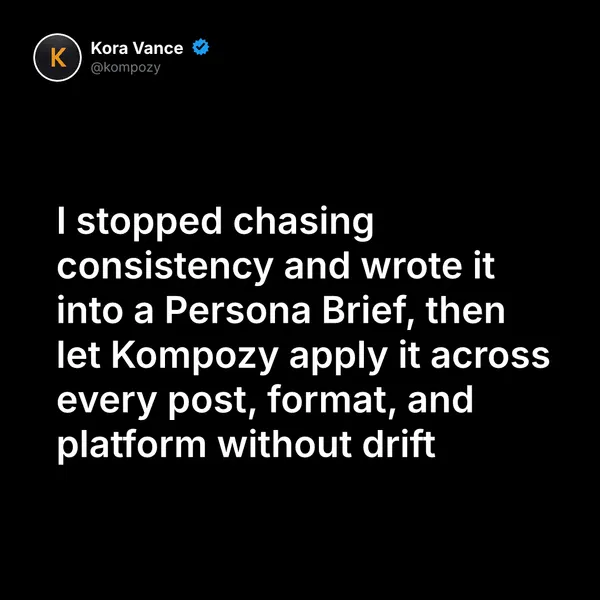
Quote Graphic from the Kompozy workspace. Short and self-contained, it can go out on the social surfaces answer engines also read.
Who is this for, and who should skip it?
Best for:
- Brands that want to be the source an answer engine quotes
- Teams publishing across a site, video, social and community surfaces
- Marketers who can back claims with specific facts and dates
Not ideal for:
- Anyone expecting one optimized page to win citations on its own
- Brands without original facts or clear positions worth quoting
Frequently asked questions
What is an AI citation?
An AI citation is the source an answer engine attaches to a claim in a generated answer — the link ChatGPT, Perplexity, Gemini, or Google's AI Overviews shows to indicate where a fact came from. Unlike a search ranking, a citation is not a reward for being the best page; it is the engine grounding its answer, showing which retrieved source supports a specific sentence so the user can verify it. Earning one means publishing a clear, specific passage that an engine can retrieve, trust, and attribute a claim to.
How do AI search engines decide which sources to cite?
They retrieve, then attribute. Given a query, an engine usually runs several searches at once (query fan-out), pulls candidate passages, and drafts an answer grounded in the ones that best match the question semantically. It then cites the specific source each claim rests on. Selection favors passages whose wording aligns tightly with the query and the drafted answer, that state a clear and checkable claim, and that come from a source the engine treats as trustworthy on that topic. It is passage-level, not page-level.
Is being cited by AI the same as being recommended?
No — they are two different jobs the same engine performs. A citation is evidential: the engine quotes a source to support a factual claim, and the cited page may not be a product at all. A recommendation is a verdict: the engine names a brand as the answer to a 'which should I use' query, drawing on its synthesized picture of the category. You can be cited as a source without ever being recommended as an option, and vice versa, so they require overlapping but distinct content.
Which sources do AI answer engines cite most?
Profound's analysis of 680 million citations across ChatGPT, Perplexity, and Google's AI Overviews (August 2024 to June 2025) found community, encyclopedic, and video sources near the top: Wikipedia led ChatGPT's citations, and Reddit led Perplexity and AI Overviews, with YouTube also prominent in AI Overviews. The skew varies by engine: Perplexity leans heavily on Reddit and recent community discussion, ChatGPT leans encyclopedic, and Google's AI answers pull video and its own indexed results more than the standalone engines do.
Does ranking on Google still help you get cited by AI?
It helps but it is not sufficient. Ranking well remains one of the stronger predictors of being cited, especially on Google's own AI surfaces, because those answers draw on the same index. But pages that do not rank on page one still get cited, because engines select passages by semantic fit and source trust, not by ranking position. Treat a strong ranked page as one input to citability, not the whole of it.
How do I get my content cited by AI search?
Publish self-contained, specific passages on the surfaces engines retrieve from. Lead each section with a direct answer that makes sense lifted out of context, back it with a concrete fact — a number, a named process, a date — and restate the subject rather than leaning on 'it' or 'as above.' Make it crawlable in the server-rendered HTML, keep your facts consistent across your site and profiles, and be present in more than one format, because citations increasingly come from articles, video, and community posts, not one page.
How do we know this?
We checked every figure, date and product claim on this page against the sources listed below on 2026-10-23, including Profound's citation analysis. We replaced a generic reference to unnamed studies with that named source. Kompozy plan and feature details come from kompozy.io and kompozy.io/pricing.
Sources
- Profound — AI platform citation patterns (read 2026-10-23)
- Kompozy — Pricing (read 2026-10-23)
- Kompozy — Homepage (formats, 8 publishing platforms, autopilot, Persona Brief) (read 2026-10-23)
Get started → · ← All guides · Compare Kompozy vs other tools