AI search brand risk (2026): how conflicting brand information wrecks your visibility and trust in AI answers — and how to close the gap
Most brand-in-AI-search advice is about being present enough to get named. This is the other half of the problem, and the one nobody audits: what happens when the facts about you contradict each other across the web. An answer engine does not read your website the way a searcher reads a page — it assembles a single picture of your brand from every place that mentions you, then decides how confident it is in that picture before it will put you in an answer. When those sources disagree — your homepage says one thing, an old press release says another, a partner portal lists a stale price, a directory has the wrong category, your rebrand landed everywhere except the three sites the model happens to trust — the model does not pick the truest source. It does something worse for you: its confidence in the whole entity drops, and low confidence has three failure modes, all of which look like a visibility problem and none of which a keyword tool will explain. It leaves you out of the answer entirely. It synthesizes a description that blends the contradictions into something subtly wrong. Or it hands your defining capability to a competitor whose story is cleaner. This guide is the practitioner read on that risk: why contradiction specifically — not absence — is the thing that hurts, the mechanics of how an engine resolves a brand into one entity and why disagreement fragments it, where the conflicting facts actually come from (rebrands, mergers, NAP drift, price and spec divergence across partner sites, schema that disagrees with the visible page, years of stale coverage), the trust problem hiding underneath it that makes the damage hard to even measure, how to audit your own exposure in an afternoon, and the fix — which is not more content but more consistent content, published across the surfaces models actually retrieve from, at a cadence that outweighs the stale signal.
Published 2026-09-07 · Updated
Short answer
AI search brand risk is the damage done when the facts about your brand conflict across the web. Answer engines build one picture of a brand from many sources and only cite it with confidence when those sources agree. When your site, old press, directories, and partner pages disagree, the model may leave you out, describe you wrongly, or credit your offering to a competitor. The fix is making every source tell the same current story.
Key takeaways
- The risk is contradiction: when sources disagree, an engine trusts your whole brand less.
- Three failure modes: you get left out, you get described wrongly, or a competitor gets credit for what you do.
- Common causes are rebrands, mergers, stale prices on partner sites, directory drift, and schema that no longer matches the page.
- Audit by asking several engines the same questions several times, then trace each wrong answer to its source.
- Publishing more only helps if every new piece describes you the same way.
What does brand risk mean in AI search?
Brand risk in traditional search was mostly about ranking: could a competitor, a review site, or a bad news story outrank you for your own name. Brand risk in AI search is a different animal, because the thing doing the searching is not a person scanning a list of ten links and deciding which to trust. It is a model that reads across many sources at once, fuses them into a single internal picture of your brand, and then answers a question in one voice — with no link for the reader to inspect and no obvious way for you to see what it read. When that fused picture is wrong or incomplete, the reader never knows there was a disagreement underneath it. They just get an answer, delivered with confidence, that quietly costs you.
The failure most brands worry about is absence — "the AI does not mention us." That is real, and the AI brand visibility gap covers it: models often recognize a brand yet never recommend it because too few independent sources attest to it. This guide is about the failure sitting next to that one and far less discussed: not too little signal, but conflicting signal. When the sources that do mention you disagree with each other, the damage is not just invisibility. It is misrepresentation — and misrepresentation delivered as fact, to a reader who cannot see the seams, is a more corrosive problem than silence.
How does conflicting brand information hurt you?
Contradictory brand data does not produce one symptom. It produces three, and they are worth separating because they feel identical from the outside — all three read as "the AI is not getting us right" — while each has a distinct mechanism and a distinct cost.
Exclusion — you vanish from the answer
The most common outcome. When an engine cannot reconcile the facts about you into something it is confident enough to state, the safe move is to leave you out. A model would rather name three brands it is sure of than five where two carry contradictions it cannot resolve. So the contradiction does not surface as a wrong answer you could spot and fix — it surfaces as your simple absence from a list you belong on, which is invisible unless you go looking. This is the failure that gets misdiagnosed as a visibility problem and "solved" by publishing more pages, when the actual blocker is that the pages already out there disagree.
Misdescription — you appear, but wrong
When the engine is confident enough to include you but the sources still disagree on the details, it synthesizes. It blends the contradictions into a plausible-sounding description that is subtly, or not so subtly, wrong: your old positioning from before a pivot, a product you discontinued, a price that has not been current for a year, a category you left. The reader receives it as established fact. This is where conflicting information turns into what practitioners now call a brand hallucination — the model is not inventing from nothing; it is faithfully reporting a web that contradicts itself, and averaging the noise into an answer.
Misattribution — your capability goes to a competitor
The most expensive and least obvious. When your story is muddled across sources and a competitor's is clean and consistent, the engine, asked who does the thing you actually do, names them. Your defining capability gets credited to the brand with the more coherent footprint, because coherence reads as authority. You are not just left off the list; the slot that should have been yours is handed to someone whose facts happen to agree with each other. Consistency, in AI search, is not a hygiene nicety — it is a competitive weapon, and inconsistency arms your rivals.
Why is AI search so sensitive to contradiction?
To fix the risk you have to understand the machinery that creates it, and it comes down to how an answer engine turns a scatter of web mentions into a thing it can talk about: entity resolution. The model does not assume your homepage is authoritative because it is yours. It looks across independent sources — your site, directories, review platforms, editorial coverage, structured data, social profiles, aggregators — and asks whether they describe the same organization with the same attributes. The more sources agree, the more confident it becomes that the entity is real, well-defined, and safe to cite. Corroboration across independent parties is the signal; a single self-published claim, uncorroborated, carries little weight. This is the same entity mechanism that decides whether a brand becomes a first-class object in a model's understanding at all.
Contradiction attacks that machinery directly. When sources disagree, two things can happen, both bad. The engine may fail to unify them — instead of one high-confidence entity, it forms competing low-weight fragments, none authoritative enough to cite. Or it unifies them but assigns the whole entity a lower confidence, because the disagreement itself is evidence that the facts are unreliable. The logic is simple: a system built to answer in one confident voice must be conservative about facts that argue with themselves.
This is also why AI search brand risk is not simply the mirror image of the visibility gap. The gap is a volume problem — too few mentions — and the answer is roughly "get mentioned more." Contradiction is a quality problem, and more mentions can make it worse: every new page that describes you slightly differently adds another conflicting vote. You can be highly present and highly at-risk at the same time. Volume without consistency is not a fix; it is an accelerant.
Where do conflicting brand facts come from?
Brand risk rarely traces back to one dramatic error. It accumulates as drift, and the sources are mundane enough that no one owns them. The most common is a rebrand or pivot that landed on the properties you control but not on the third-party profiles the model trusts — your site says you are a full platform, half the web still calls you the single-feature tool you launched as. Mergers and name changes are worse, because they leave the brand described in two live states at once, and the model has no way to know which is current.
For anything with a physical or local footprint, NAP inconsistency — name, address, and phone details that diverge across directories and listings — is the classic entity-fragmenter, and it is why local businesses are especially exposed; the local SEO signals for AI search guide goes deep on that specific case. For products, prices and specs that differ between your own site and reseller or partner portals give the model directly conflicting numbers to average. A redesign that left your JSON-LD structured data describing the old page is a quiet one: when the machine-readable layer contradicts the visible text, the engine reads it as an integrity problem and trusts the whole URL less. And underneath all of it sits the archive — years of press releases and old posts describing an earlier version of the company that the model still reads as present tense, because nothing told it otherwise.
Why do AI answers describe the same brand differently?
There is a second layer to this risk that makes it genuinely hard to manage: even a perfectly consistent brand gets described differently across repeated queries, because these systems are probabilistic. Research published in January 2026 by Rand Fishkin of SparkToro and Patrick O'Donnell of Gumshoe.ai, in which 600 volunteers ran a shared set of test prompts nearly 3,000 times across ChatGPT, Claude, and Google's AI, found the outputs so variable that there was less than a one-in-a-hundred chance the same brand list came back twice across a hundred asks of the same question. That baseline variability is not itself the risk — but it is what makes the risk so hard to see. When the answer changes every time anyway, a wrong or missing mention looks like noise, so the underlying contradiction never gets diagnosed. You cannot fix what you have written off as randomness.
The trust cost runs the other direction too. Because an answer engine delivers everything in the same confident, sourceless voice, a reader has no way to tell a well-corroborated fact from an averaged-out contradiction. When the model states something wrong about you as if it were settled, the reader believes it — and if they later discover it was wrong, the credibility hit lands on your brand, not on the model. That is a double bind for you: a reader who acts on the answer before checking carries the wrong fact forward, and one who checks later blames your brand for it. Consistency is how you make the confident voice tell the truth about you.
How do you audit your own AI search brand risk?
You cannot manage this by intuition, so start by seeing what the models actually say. Ask several engines — ChatGPT, Gemini, Perplexity, Google's AI mode — the same set of questions, and ask each one several times, because the variability above means a single response tells you almost nothing. Run three kinds of prompt: describe-me ("what is [brand]"), which surfaces your stored identity; the buyer's category question ("best options for [what you do]"), which shows whether you appear at all; and the pointed fact checks ("how much does [brand] cost," "what does [brand] do," "where is [brand] based"), which expose the specific contradictions. Log what comes back and look for disagreement — between engines, between runs, and against the truth.
Then trace the wrong answers to their sources. Where the model describes an old positioning, find the stale pages still carrying it. Where it has the wrong price or category, find the profile or portal feeding that number. Where it omits or misattributes you, look for the thin, contradictory footprint behind the silence. The output of this audit is not a vibe; it is a concrete list of contradicting sources ranked by how load-bearing they seem to be. That list is your remediation queue, and it is worth far more than another round of keyword research, because it names the actual thing breaking your visibility.
How do you fix AI search brand risk?
The remedy follows directly from the mechanism: make the web agree about you. Write one canonical description of what you do, who you serve, and where you sit — the single sentence you want the model to learn — and then propagate it, unchanged, everywhere you control. Homepage and about page, Organization schema with clean structured data, social bios, and the high-authority third-party profiles engines lean on. Use sameAs links and a coherent entity setup so the engine can tie every profile back to one organization rather than several fragments. Correct the stale sources you can reach directly, and for the ones you cannot, the play is to outweigh them: publish a steady stream of fresh content that all tells the current, corroborated story, so the recent consistent signal accumulates faster than the old contradictory signal decays.
That last move is the one most teams get backwards, and it is the bridge between this risk and the wider governance problem. Scaling content is supposed to build corroboration — but if every piece is generated loose, with each post improvising a slightly different description of the brand, you are not corroborating, you are manufacturing the exact contradictions that create the risk. That tension between shipping at volume and staying consistent is the subject of AI content growth vs brand governance; for the get-recommended mechanics that sit on top of a clean entity, see AI SEO and brand visibility in chat discovery. The through-line is the same: consistent, corroborating signal published across the surfaces models retrieve from is what turns a fragmented, at-risk brand into a resolvable one.
Where does Kompozy fit in reducing brand risk?
The risk on this page is conflicting signal; the fix is a large, current supply of consistent signal across the surfaces models read. Kompozy is built to produce exactly that, and it matters precisely because the naive way to "publish more" is what causes the problem. A content engine with no governing brief will describe your brand a little differently in every post — a different phrasing of what you do, a different emphasis, a stray old claim — and at volume that becomes dozens of contradicting votes the model has to average. Kompozy inverts it. Every generation is held to one written Persona Brief that fixes how the brand is described, with banned-word filters rejecting off-message output, so scaling multiplies a single consistent description of you instead of manufacturing variants of it. That is the difference between content that corroborates your entity and content that fragments it.
The second half is spread. An entity resolves when the same story shows up across many independent surfaces, so a consistent description trapped on one blog does little. Kompozy publishes that governed output across up to 9 platforms, with per-post review or opt-in Autopilot keeping a steady, corroborating cadence live on the surfaces answer engines actually retrieve from — social feeds, editorial-style posts, video. Because the same governing brief drives net-new formats too — Persona Shorts and avatar video, Carousels and Photo Posts, blogs, newsletters — the identical description of your brand shows up in the model's field of view in many shapes at once, all agreeing. Volume that agrees with itself is corroboration; that is the signal that lifts confidence and pulls you out of the exclusion and misdescription failure modes.
Be clear about the boundary, because it decides how you use this. Kompozy governs and publishes the signal you own — your site content and your social and email footprint — which is a large share of what models retrieve, but not all of it. It does not edit your Wikidata entry, your Crunchbase profile, a reseller's price page, or a review site; those stale or conflicting third-party sources you correct by hand, using the audit above as the queue. What Kompozy removes is the risk on your own side of the ledger — it guarantees that everything you produce and ship describes you the same way, at a cadence that lets the current story outweigh the old one, so your scaling effort reduces contradiction instead of adding to it. Fix the third-party facts once; let a consistency engine keep the ongoing flow from ever drifting again.
What does this look like in Kompozy?
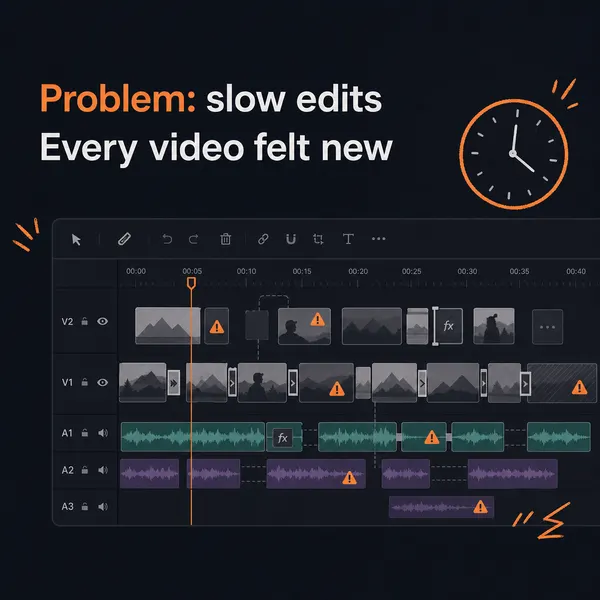
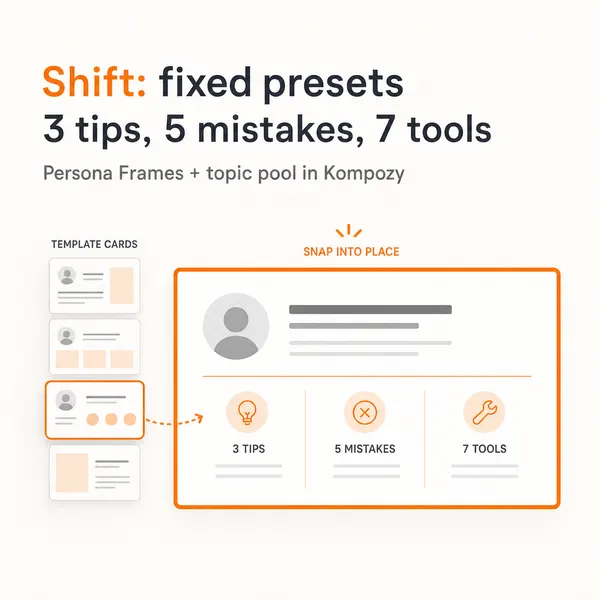
A real five-slide carousel made in the Kompozy workspace. Every slide follows one brand template, which is the kind of consistent description this guide says helps answer engines trust a brand.



Who is this for, and who should skip it?
Best for:
- Brands that rebranded, pivoted, merged, or changed pricing and still see the old story in AI answers
- Local and multi-location businesses with inconsistent listings across directories
- Teams scaling AI content who need every post to describe the brand the same way
Not ideal for:
- Brands that are simply unknown, which is a visibility gap more than a consistency problem
- Fixing third-party records such as Wikidata, Crunchbase, or reseller pages, which you correct by hand
- Anyone hoping for an exact consistency score, since the SparkToro research shows answers vary run to run
Frequently asked questions
What is AI search brand risk?
It is the risk that answer engines like ChatGPT, Google AI Overviews, Gemini, and Perplexity damage your brand because the information about you across the web conflicts. An engine builds one picture of your brand from many independent sources and scores how confident it is in that picture. When sources contradict each other — different descriptions, stale prices, wrong categories, an old name — confidence drops, and the model responds by leaving you out of answers, describing you inaccurately, or crediting your offering to a competitor. The risk is not being unknown; it is being known inconsistently.
How does conflicting information hurt my visibility in AI search?
Through three failure modes. Exclusion: when the facts do not corroborate each other, the model is not confident enough to name you, so you simply do not appear in the answer. Misdescription: it synthesizes a blended, subtly-wrong summary from the contradictory sources — an old positioning, a discontinued product, a wrong price. Misattribution: your defining capability gets assigned to a competitor whose story is cleaner and more consistent. All three read to you as "the AI does not mention us," but the cause is contradiction, not absence — which is why publishing more pages without fixing the conflict does not help.
Why is AI search so sensitive to inconsistent brand data?
Because of how it resolves an entity. An answer engine does not treat your homepage as authoritative by default; it looks for the same facts corroborated across many independent sources and grows more confident the more they agree. Consistent signal across sites unifies into one high-confidence entity it will cite. Contradictory signal does the opposite: it can fragment into competing low-confidence entities, or drop the whole entity below the threshold the model needs to state something as fact. Corroboration is the currency, and contradiction spends it.
Where does conflicting brand information usually come from?
Rarely from one big error — usually from accumulated drift. Rebrands and pivots that landed on your own site but not on the third-party profiles models trust. Mergers and name changes that live in two states at once across the web. NAP (name, address, phone) inconsistency across directories for local businesses. Prices and product specs that diverge between your site and reseller or partner portals. Structured data (JSON-LD) that no longer matches the visible page after a redesign. And years of press and old blog posts describing an earlier version of the company that the model still reads as current.
How do you fix AI search brand risk?
By making the web agree about you. Settle on one canonical description of what you do, who you serve, and where you sit, then propagate it everywhere you control — homepage, structured data, social bios, key third-party profiles — and use sameAs links and clean Organization schema so engines can tie the profiles to one entity. Correct the stale sources you can reach and drown the ones you cannot with a steady stream of fresh, consistent content across the surfaces models retrieve from, so the current, corroborated story outweighs the old one. It is an entity-consistency problem, not a keyword problem.
How do we know this?
We checked the SparkToro and Gumshoe consistency research cited on this page against the sources listed below on 2026-10-23, and removed or reworded any figure we could not confirm. Kompozy plan, format, and platform details come from kompozy.io/pricing and the Kompozy glossary.
Sources
- SparkToro — AIs are highly inconsistent when recommending brands or products (read 2026-10-23)
- Search Engine Journal — AI recommendations change with nearly every query (read 2026-10-23)
- Kompozy — Pricing (read 2026-10-23)
- Kompozy — Autopilot (glossary) (read 2026-10-23)
Get started → · ← All guides · Compare Kompozy vs other tools