AI search intent in 2026: how answer engines changed what a query wants — and how to map content to the intent behind it
Search intent used to be a tidy four-box model: a query was informational, navigational, commercial, or transactional, and you matched a page to the box. AI search broke the tidiness. Queries are now long, conversational, and multi-step, so a single session moves through several intents at once — someone exploring a problem, comparing options, and deciding, all in one thread of follow-ups — and the answer engine resolves most of it on the results surface without a click. This guide is about intent, not phrasing: it separates the classic intent buckets (which still exist under the hood) from the new intent shapes practitioners now see in ChatGPT, Perplexity, and Google's AI answers; explains why one query has become a journey the engine walks the user through; and lays out how to map content to the intent behind a question rather than the keyword in it. It also draws the honest line — that satisfying AI-search intent means producing content in the right shape for every stage of that journey, and being present on the surfaces the follow-up query lands on, which is a production problem more than an optimization one.
Published 2026-09-09 · Updated
Short answer
AI search intent is what a person actually wants when they ask an answer engine a question. The classic informational, navigational, commercial, and transactional buckets still exist, but AI queries are longer and one conversation often moves from exploring to comparing to deciding. Google says the average AI Mode search is triple the length of a traditional one. Win by matching content to each stage of that journey, not to one keyword.
Key takeaways
- The four classic intent types still apply; AI search blends them inside one longer question.
- Google says the average AI Mode search is triple the length of a traditional Search query.
- In Nectiv's analysis, ChatGPT ran 2.17 searches per prompt when it searched the web.
- Map content to stages: explainers for exploring, honest comparisons for weighing options, specific evidence for deciding.
- Many answers resolve without a click, so being cited during the early stages is what earns the later visit.
How has AI search changed search intent?
Search intent is the oldest useful idea in SEO: figure out what a person actually wants from a query, then give them exactly that. For years the model was a tidy four-box grid — a query was informational, navigational, commercial, or transactional, and you matched one page to one box. AI search did not throw the grid out, but it broke the tidiness. Queries are now long, conversational, and multi-step, so a single session moves through several intents at once, and the answer engine reads the intent from a full sentence and resolves most of it on the spot. The practical unit of optimization stopped being "rank a page for a keyword" and became "satisfy the intent a whole conversation is circling."
This guide is about intent specifically — not how queries are phrased, which is a related but separate shift covered in AI search behavior is replacing keywords. Here the focus is the goal behind the words: which classic intent buckets still hold, which new intent shapes answer engines have surfaced, why one query has become a journey the engine walks the user through, and how to map content to the intent behind a question rather than the string in it. It ends on the honest boundary — that answering AI-search intent well is as much a production problem as an optimization one.
What did search intent mean before AI, and why is it shifting?
Classic search intent is inferred from a fragment. Someone types "running shoes," and you guess whether they want to learn, find a brand, compare, or buy — usually from two or three words, one query at a time, and you point a single ranked page at that guess. The whole discipline was built around the fact that a short query is ambiguous, so the engine (and the marketer) had to bet on the most likely want and hope the click confirmed it.
AI search removed most of that ambiguity by removing the fragment. People now ask answer engines full, context-rich questions the way they would ask a knowledgeable colleague. Google says the average AI Mode search is triple the length of a traditional Search query. Even the web searches ChatGPT runs on a user's behalf are long: Nectiv's analysis of more than 8,500 prompts found they averaged 5.48 words, against a 3.4-word US average. A longer query carries its own context, so the engine no longer has to guess the intent from shorthand — it reads it. That is the first shift: intent moved from inferred to stated.
Do the four classic search intents still exist?
Traditional intent is not dead. Engines still tokenize and retrieve on the same underlying signals, and the four categories are still the honest foundation for reasoning about what a query wants: informational (learn something), navigational (reach a specific brand or page), commercial (research before a purchase), and transactional (act or buy). A query asking how to unclog a drain is informational; a query asking to buy a specific drain snake is transactional. AI search does not change that.
What it changes is that the engine rarely sees one intent in isolation. Because the query is a full sentence and the session is a conversation, a single request often carries two or three of the classic intents at once — "what's the best budget drain snake for a clog under a kitchen sink, and where can I get one today" is informational, commercial, and transactional in one breath. The answer engine reads all of it and responds with a blended answer: an explanation, a comparison, and a recommendation, sometimes with a purchase surface attached. The buckets did not disappear; they stopped arriving one at a time.
What new intent shapes did AI search add?
On top of the classic four, practitioners working in ChatGPT, Perplexity, and Google's AI answers increasingly describe intent shapes that map better to how conversational search actually behaves. Treat these as a working lens rather than settled canon, but they are useful because they name what a single keyword bucket cannot.
Exploratory intent
The searcher is not looking for one fact; they are trying to understand a space, and they will refine through follow-ups. The opening query is broad on purpose ("how does AI search change content marketing"), and the real intent reveals itself over the next three or four turns. Content that wins exploratory intent is a clear, well-structured explainer that gives the engine something solid to summarize on turn one and something to build on when the user narrows in on turn three.
Comparative research intent
Instead of running separate searches for each option and reconciling them by hand, the searcher asks the engine to weigh options inside one answer — "compare the two most-cited approaches and tell me which fits a small team." The intent is a decision-in-progress. Content that serves it is an honest, structured comparison: named options, real trade-offs, and a clear statement of who each one is for, in a form the engine can lift into its own comparison without distortion.
Synthesis and decision intent
The deepest AI-search intent asks the engine to combine multiple sources into a single recommendation — "based on the evidence, what should I do." This is where answer engines are most different from a link list: the user wants a synthesized verdict, not ten tabs. Content that gets pulled into a synthesis answer is specific and evidence-bearing — concrete numbers, named sources, a defensible position — because a synthesis engine preferentially quotes the passage that states a clear, supportable claim it can attribute.
Why is one AI query now a journey?
The single biggest change to intent is structural: a query is no longer an event, it is a step. Answer engines increasingly run several searches for one user prompt — a behavior called query fan-out — and in Nectiv's analysis, when ChatGPT did search the web it ran 2.17 queries per prompt on average; the user then refines with follow-ups on top of that. So a topic gets resolved through a chain of linked queries that move across intents: an exploratory opener, a comparative middle, a decision close. The intent you are trying to satisfy is spread across that whole chain, not concentrated in the first query.
This is why intent mapping replaced keyword mapping as the organizing job. You are no longer trying to own one exact-match phrase; you are trying to be the source the engine keeps reaching for as the user moves from "help me understand this" to "help me choose" to "tell me what to do." A page that only answers the exploratory opener leaves you invisible at the moment the decision is made, and vice versa. The related discipline of shaping content so engines can retrieve and quote it is generative engine optimization; intent mapping is what tells you what to make so there is something worth retrieving at every step.
How does zero-click search change intent?
There is a hard consequence to intent moving onto the answer surface: a large and growing share of searches now resolve without a click, because the engine satisfies the intent in place. When the answer is delivered directly, the informational and comparative intents are often fully served on the results surface, and the click — if it happens at all — comes late, at the decision stage, if you were named in the answer. So the value of a page shifted from "win the click for this intent" to "be the source the engine cites while it serves this intent."
That reframes what optimizing for each intent even means. For an exploratory or comparative query you may never get the visit, so the goal is the mention inside the answer, which compounds into the brand being recommended later. For a decision query the click is still real, but you only earn it if you were present and trusted through the earlier, clickless stages. Intent optimization in a zero-click world is therefore cumulative — you are building presence across the whole journey so you are the obvious name when the one clickable moment arrives. The broader playbook for that is in AI search content strategy.
How do you map content to AI-search intent?
The operating shift is simple to state and hard to execute: build content around intents and questions, and let the keywords follow. Concretely, that means producing something purpose-shaped for each stage of the journey rather than one all-purpose page.
For exploratory intent
Publish clear explainers and definitions written so a machine can summarize them cleanly and a follow-up can build on them. Lead with a direct answer, then structure the depth beneath it. This is the content that gets you into the answer on turn one and keeps you in the conversation as the user narrows.
For comparative intent
Structure honest comparisons the engine can lift without you losing the framing — named options, real trade-offs, an explicit "who this is for." State the competitor's genuine strengths; an engine that trusts your comparison is more likely to quote your recommendation, and a one-sided pitch reads as unreliable and gets skipped.
For decision and synthesis intent
Give specific, extractable answers backed by named evidence — numbers, sources, a defensible position. Synthesis engines preferentially pull the passage that states a clear, supportable claim. Vague, hedged content is invisible at the decision stage precisely because there is nothing citable in it.
Then the part most intent guides skip: cover the journey across surfaces, not just formats. Because AI search resolves a topic through many linked queries — and increasingly cites video, social posts, and community content alongside articles — the follow-up that closes the loop may land on YouTube, LinkedIn, or a blog rather than the page you optimized. Being present in the right shape on the surface where each intent stage plays out is the actual game, and it is why intent optimization has quietly become a content-production problem.
Where does Kompozy fit in covering the intent journey?
Mapping intent is analysis; covering it is output. Satisfying AI-search intent means shipping an explainer for the exploratory opener, an honest comparison for the middle, a specific evidence-backed answer for the decision — and doing it across the surfaces answer engines actually pull from, on a cadence, without a separate production run per format. That is a throughput problem, and it is where Kompozy earns its place. It is an AI content generation and multi-platform publishing engine, not an intent-tracking tool — and that is the point, because the bottleneck is not knowing which intent to serve, it is producing enough on-brand content to serve all of them.
Mapped to the journey, the fit is concrete. Exploratory intent wants explainers and definitions: Kompozy generates blog articles, text posts, and long-form copy governed by a Persona Brief so the voice stays consistent across a whole topic cluster. Comparative and decision intent want structured, citable pieces plus presence on cited surfaces: it produces brand-exact carousels, quote graphics, and infographics, and — because AI search increasingly quotes video — talking-head Persona Shorts, clipped shorts, and avatar video for YouTube, TikTok, and the social feeds. One idea fans into the twenty formats a full intent journey needs, held to one brand identity so every stage reads as the same trusted source rather than scattered one-off posts.
Then it closes the surface gap the journey demands. Kompozy publishes and schedules across up to 9 platforms, through a per-post review pipeline for manual approval or, source by source, Autopilot — which generates and schedules without human review, gated instead by automated quality checks — so you are actually present wherever the next query in the chain lands, at the volume that builds the cumulative, zero-click presence AI-search intent now rewards. The honest boundary: an engine does not manufacture intent understanding or replace a real point of view, and volume without real editorial judgment produces the hedged filler answer engines skip. Kompozy is what turns a clear intent map into content that exists at every step of it — the production layer, not the strategy.
Is AI search intent a new idea?
AI search intent is the same old question — what does this searcher actually want — asked under new conditions. The classic informational, navigational, commercial, and transactional buckets still hold, but AI search reads intent from a full conversational sentence, blends several intents into one answer, and resolves a topic through a chain of linked queries that mostly end without a click. The shift for content is from targeting keywords to serving the intent behind a whole line of questioning, in the right shape at every stage, on the surfaces each stage lands on. Map the journey, then produce for all of it — because in an answer-engine world, the source that is present and citable through the exploratory and comparative stages is the one that gets recommended when the decision finally comes.
What does this look like in Kompozy?
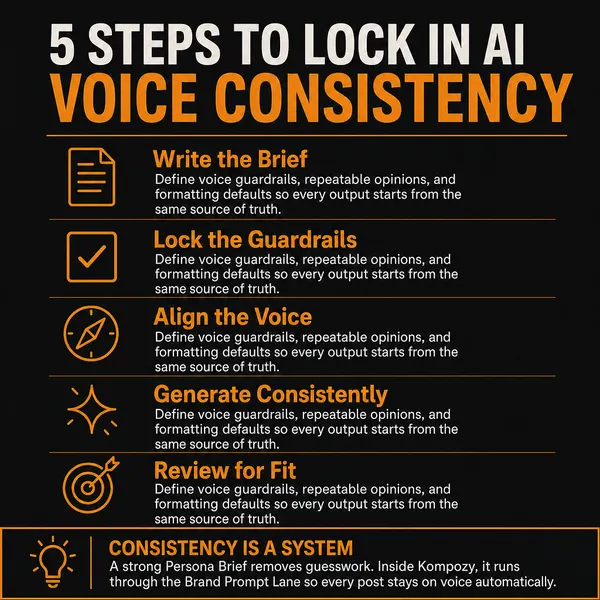
A real infographic photo post made in the Kompozy workspace. It is one of the structured, citable formats this guide suggests for the comparison and decision stages of a search.
Who is this for, and who should skip it?
Best for:
- Content teams moving from keyword lists to question- and journey-based planning
- Brands that need explainers, comparisons, and decision content across blog, social, and video
- Marketers who want one source idea turned into content for each stage of a topic
Not ideal for:
- Teams that need intent tracking or analytics, which Kompozy does not provide
- Pages that only target one transactional keyword with nothing to compare or explain
- Anyone hoping volume alone wins without a real point of view in the content
Frequently asked questions
What is AI search intent?
AI search intent is what a searcher actually wants when they ask an answer engine like ChatGPT, Perplexity, Gemini, or Google's AI answers a question — the goal behind the query, not the literal words. It is the same underlying concept as classic search intent, but AI-era queries are longer and conversational, so a single question carries more context and a single session usually spans several intents at once: exploring a topic, comparing options, then deciding. The engine reads that intent from natural language and answers it directly, which is why matching content to intent now matters more than matching it to a keyword.
What are the search intent types in AI search?
The classic four still exist under the hood — informational (learn something), navigational (reach a specific brand or page), commercial (research before a purchase), and transactional (act or buy). AI search does not delete them; it blends them and adds shapes on top. Practitioners increasingly describe AI-search intent in terms of exploratory queries (open-ended learning through follow-ups), comparative research (weighing options in one answer), and synthesis or decision queries (asking the engine to combine sources into a recommendation). Most real AI sessions move through more than one of these.
How is AI search intent different from keyword intent?
Keyword-era intent was inferred from a two- or three-word fragment, one query at a time, and mapped to one page. AI search intent is inferred from a full, context-rich sentence — Google says the average AI Mode search is triple the length of a traditional Search query — and it plays out across a multi-step conversation rather than a single query. So you are no longer targeting an exact-match phrase; you are trying to satisfy the intent a whole line of questioning is circling, across several answers.
Did AI kill traditional search intent?
No. The four classic intent categories are still the honest foundation — engines still tokenize and retrieve on them under the surface, and a transactional query is still transactional. What changed is that AI search rarely sees a query in isolation. It reads intent from a longer sentence, often runs several searches for one prompt (query fan-out), and stitches the results into one answer, so the practical unit of optimization shifted from a single ranked page to a whole intent journey that content has to cover at every stage.
How do I optimize content for AI search intent?
Map content to the intent behind the question, not the keyword. For exploratory intent, publish clear explainers and definitions that a follow-up can build on. For comparative intent, structure honest comparisons the engine can lift into a recommendation. For decision intent, give specific, extractable answers with named evidence. Then cover the whole journey across formats and surfaces, because AI search resolves a topic through many linked queries that land on different platforms — a blog, a video, a social post — not one page.
How do we know this?
We checked Google's AI Mode query-length figure and Nectiv's ChatGPT search data against the sources listed below on 2026-10-23, and removed or reworded any figure we could not confirm. Kompozy plan, format, and platform details come from kompozy.io/pricing and the Kompozy glossary.
Sources
- Google — AI Mode U.S. insights (read 2026-10-23)
- Digital Information World — How often does ChatGPT search the internet (Nectiv study) (read 2026-10-23)
- Kompozy — AI tool stack recommender (read 2026-10-23)
- Kompozy — Pricing (read 2026-10-23)
Get started → · ← All guides · Compare Kompozy vs other tools