AI visibility and GEO in 2026: the outcome and the practice, how the two fit together, and how to run them as one measurable loop
AI visibility and GEO get used interchangeably, and treating them as the same thing is the fastest way to run the program badly. They are not synonyms — they are the two halves of one loop. AI visibility is the outcome: how often an answer engine like ChatGPT, Perplexity, Google's AI Overviews, or Gemini names you, cites you, recommends you, or ignores you when someone asks a question in your category. It is a thing you measure. GEO — generative engine optimization — is the practice that moves that outcome: the content work, structure, sourcing, and distribution that make a model more likely to pull from you. GEO is the input; AI visibility is the output; and the reason to keep them separate in your head is that the output is what you report on and the input is what you actually control. This guide draws the line cleanly, then does the useful part. It defines the AI-visibility KPIs that matter in 2026 — share of voice, citation rate, recommendation rate, prompt coverage, and sentiment — and how each is actually computed, so a number on a dashboard means something. It explains the GEO levers the founding research and the last two years of practice show actually move those numbers, and the ones (keyword density chief among them) that do not. It walks the closed loop — optimize, measure across engines, learn, feed back — including the two hard measurement realities most write-ups skip: the noise floor that makes small week-to-week swings meaningless, and the fact that the major engines barely cite the same sources, so one number is never enough. And it shows where a generation-and-publishing engine turns the loop from a manual, one-page-at-a-time grind into a maintained production system, because AI visibility is a corroboration game won by consistent presence across many surfaces, not by perfecting a single hero page.
Published 2026-09-11 · Updated
Short answer
AI visibility is the outcome: how often answer engines like ChatGPT, Perplexity, Google's AI Overviews and Gemini mention, cite or recommend your brand. GEO, generative engine optimization, is the practice that earns it. Treat them as one loop. Do the GEO work, then measure share of voice, citation rate, recommendation rate, prompt coverage and sentiment on a frozen prompt set across several engines, and feed the gaps into your next round of content.
Key takeaways
- GEO is the input you control. AI visibility is the output you report on.
- Track five metrics on a fixed prompt library: share of voice, citation rate, recommendation rate, coverage, sentiment.
- The KDD 2024 GEO paper found quotations, statistics and cited sources lifted visibility by up to 40%. Keyword stuffing did not help.
- A 2026 study of 118,000 AI responses found only 11% of cited domains showed up on more than one platform.
- Run many prompts several times each and read each engine separately. Small weekly swings are usually noise.
Are AI visibility and GEO the same thing?
No. "AI visibility" and "GEO" get thrown around as if they were the same thing, and conflating them is the most common way teams run this program badly. They are the two halves of one loop, and the whole discipline gets clearer the moment you separate them.
AI visibility is an outcome. It is how often an AI answer engine — ChatGPT, Perplexity, Google's AI Overviews and AI Mode, Gemini, Bing Copilot — names your brand, cites your page, recommends you as an option, or leaves you out entirely when someone asks a question in your category. It is a thing you measure. It has units. You can put a number on it this week and a different number on it next month and know whether you moved.
GEO — generative engine optimization — is a practice. It is the content work that moves that outcome: writing clear direct answers, adding cited data, quoting credible voices, structuring passages so a model can lift them cleanly, keeping your brand's facts consistent everywhere, and distributing all of it across enough credible surfaces that the models have something to corroborate. GEO is what you do. AI visibility is what happens as a result.
Hold that distinction and two things fall into place. First, you stop reporting on your inputs as if they were results — "we published 12 GEO-optimized pages" is an activity, not an outcome; the outcome is whether your share of voice went up. Second, you stop trying to "do AI visibility," which is like trying to do a higher temperature instead of turning up the heat. You do GEO. You measure AI visibility. Then you close the loop between them.
What does AI visibility measure?
AI visibility is not one number, and any tool that hands you a single "visibility score" is compressing several different questions into one. Five metrics carry the real signal in 2026. Every one of them is computed over a fixed set of prompts — a frozen library of the questions your buyers actually ask — run repeatedly across multiple engines. Change the prompt set and every number changes, so the prompt library is the measurement instrument; treat it as fixed.
Share of voice (mention rate)
The headline metric. Of all the answers your prompt set produced, what fraction mentioned your brand at all? If you run 40 category questions across four engines and your name appears in 30 of the 160 answers, your share of voice is roughly 19%. It is the easiest metric to move and the easiest to over-read, because a mention in passing counts the same as a recommendation. Useful as a trend line, weak as a single point.
Citation rate (citation share)
The harder, more valuable number. How often is your domain actually one of the sources the engine links or footnotes? A mention means the model knows you exist; a citation means it pulled from your page specifically to build the answer. Citation share is your cited answers divided by all answers in the set, and it is the metric that most directly reflects GEO working, because it is the model choosing your content as evidence rather than recalling your name from training.
Recommendation rate
Isolates the answers where you are named as a suggested option — "tools like X and Y" — not just referenced in the background. For anyone selling something, this is the money metric: it is the AI-era equivalent of making the shortlist. It is usually far smaller than your mention rate, and the gap between the two tells you whether the models see you as a real contender or just a name they've encountered.
Prompt coverage
How many of your target questions surface you at all, versus never returning you regardless of engine. Coverage answers a different question from share of voice: not "how loud are we in the answers we appear in," but "how many of the rooms are we even in." Low coverage points at whole topic clusters where you have no citable content; high coverage with low share points at content that exists but isn't winning the citation.
Sentiment
How you are described when you are named. A brand can have strong visibility and be consistently framed as the expensive option, or the outdated one, or confused with a competitor. Sentiment is the metric that catches brand-consistency problems the other four miss, and it is the one most likely to surprise a team that only tracked whether they appeared.
What does GEO do?
If AI visibility is the scoreboard, GEO is the set of moves that changes it. The founding academic work is the anchor: the 2023 paper that coined the term, published at the KDD conference in 2024, tested optimization tactics against a benchmark of thousands of queries and found the winners were content-level signals of authority — adding statistics, adding quotations from credible sources and citing sources raised a source's visibility in generative answers by up to 40%, with the size of the effect varying by domain. The notable negative result: keyword stuffing, the reflex carried over from old SEO, offered little to no improvement. Generative engines reward quotable substance, not keyword density.
On the page, that translates to a handful of concrete habits. Open with a direct one-to-three-sentence answer to the question the page is about, before any preamble, because that is the passage an engine can lift verbatim. Back claims with real, sourced numbers rather than adjectives. Quote named people with credentials. Structure the page so each section answers one question cleanly — an FAQ block where every answer stands alone is close to purpose-built for extraction. Add schema markup so a retrieval system can parse the page's structure without guessing.
Off the page is where most teams under-invest and where the durable gains live. Models corroborate: before naming a source, they cross-check whether the wider web agrees. A single perfect page rarely gets cited if nothing else backs it up, while a brand mentioned consistently and on-message across many credible surfaces — its own site, third-party articles, social platforms, communities, video — is the one the model trusts enough to name. Consistency of your core facts across all of it is its own lever; conflicting descriptions of what you do are a visibility tax. This is why AI visibility is fundamentally a distribution problem wearing a content costume.
How do GEO and AI visibility work as one loop?
Once the two are separated, the operating model is obvious: it is a closed loop, not a launch. Optimize content (GEO). Measure the outcome across engines (AI visibility). Learn which prompts you win, which you lose, and how you are described. Feed that back into the next round of content. Repeat on a cadence.
The feedback is the part that makes it a program rather than a checklist. Your prompt library is a map of demand; the measurement tells you where on that map you are present, absent, or mis-described. A cluster of comparison queries where you never appear is a brief for a comparison page. A question you get mentioned in but never recommended for is a brief for a stronger, better-sourced answer. A place where the model describes you wrong is a brief for consistent, corrective content across surfaces. GEO without measurement is guessing; measurement without a content engine to act on it is a dashboard nobody can move.
How do you measure AI visibility honestly?
Two realities separate a credible AI-visibility program from a vanity dashboard, and most write-ups skip both.
The first is the noise floor. LLM answers are non-deterministic — ask the same question twice and you can get different sources — so any single run is a sample, not a truth. Many of the week-to-week share differences teams celebrate or panic over sit inside the measurement noise, indistinguishable from randomness. The discipline is to run a frozen prompt set enough times to get a stable estimate, report every share with the number of runs behind it, and call an insignificant swing insignificant. A daily number off a single run per prompt is theater; a monthly number off many runs is a metric.
The second is that the engines do not agree. A 2026 study of 118,000 AI responses across ChatGPT, Perplexity, Google AI Mode and Claude found that only about 11% of cited domains appeared on more than one platform. The surfaces barely draw from the same web. That kills any "my AI visibility is 34%" one-number claim, because visibility on ChatGPT, on Perplexity, on Google's AI Overviews, and on Gemini are effectively four different scoreboards. You have to measure across all of them and read them separately, or you are optimizing for an average that describes no engine anyone actually uses.
How do you run the GEO loop at production scale?
GEO is not a setting you toggle or a plugin you install. It is a production problem. "Publish a directly-answered, well-sourced page for each cluster where you're absent, keep your facts consistent across every surface a model reads, and refresh it as the answers move" is a description of a content operation, not a task. And because the winning lever is corroboration — consistent presence across many surfaces — the work does not shrink to one hero page. It is many on-brand assets, across formats and platforms, kept current. That is exactly the workload that makes AI visibility feel unwinnable for a small team doing it by hand.
This is where a generation-and-publishing engine changes the economics of the loop. Kompozy is built for the supply side of AI visibility: you write the authoritative thing once, and it fans out into a blog article, a set of posts for 9 social platforms, a newsletter, and short-form video, all governed by a single Persona Brief so your claims, facts, and voice stay identical wherever a model finds them. Consistency across surfaces — the thing that gives answer engines enough corroborating sources to name you — stops being a coordination nightmare and becomes a property of how the content is produced.
The formats map directly onto the citation research. Data studies and infographics carry the primary statistics engines favor. Carousels and quote graphics push a consistent claim across social, one of the surfaces AI answers increasingly pull from. Blogs and newsletters hold the liftable, directly-answered passages. And because AI visibility is a maintained asset rather than a publish-once win — the answers drift, competitors move, your facts go stale — Kompozy's autopilot keeps the corroborating layer refreshed on a cadence instead of decaying the week after you stop. Every output is generated under rules that forbid invented statistics and off-brand language, and you can hold posts for review before they publish. Check every figure anyway, which matters more here than anywhere: fabricated numbers are exactly what gets a page pulled from an engine's consideration and erodes the trust GEO depends on.
None of that measures your visibility for you — that is a separate discipline, and you still need a frozen prompt library run across the engines to know whether you moved. What the engine removes is the bottleneck on the input side of the loop, so the thing you learn from measurement can actually be acted on at the scale and consistency the models reward.
What does a first-month GEO plan look like?
If you are standing this up from zero, the first month is mechanical. Build the prompt library — 15 to 50 real buyer questions across brand, category, and comparison clusters — and freeze it. Run it across ChatGPT, Perplexity, Google's AI Overviews, and one of Gemini or Claude, several runs each, and record share of voice, citation rate, recommendation rate, coverage, and sentiment per engine. That is your baseline, and it will almost certainly be lower and more uneven across engines than you expect.
Then act on the gaps in priority order: clusters with zero coverage (you have nothing citable — make it), questions where you are mentioned but never recommended (your answer isn't strong or sourced enough — strengthen it), and anywhere the models describe you wrong (a consistency problem — fix it everywhere, not just on your site). Re-run the frozen set monthly, report the deltas with their run counts, and keep feeding the results back in. The teams that win AI visibility are not the ones with the cleverest single page — they are the ones running this loop while everyone else is still arguing about whether GEO and AI visibility are the same thing.
What does this look like in Kompozy?
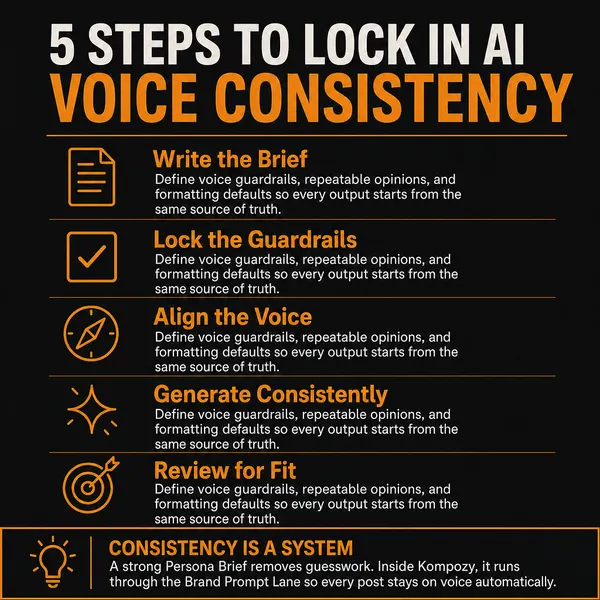
A real infographic photo post generated in the Kompozy workspace. Data-led visuals like this are one way to repeat the same sourced claim across social surfaces that answer engines read.
Who is this for, and who should skip it?
Best for:
- Marketing teams setting up an AI visibility program and choosing what to measure
- SEO leads who need to explain how GEO differs from SEO and how to report on it
- Brands that can publish consistent, well-sourced content across many surfaces
Not ideal for:
- Anyone wanting a single 'AI visibility score'; the guide argues one number hides the real picture
- Teams without time to keep a prompt library and rerun it monthly
- Readers looking for a tool comparison; this explains the metrics and the loop, not vendors
Frequently asked questions
What is the difference between AI visibility and GEO?
AI visibility is the outcome you measure — how often AI answer engines like ChatGPT, Perplexity, Google's AI Overviews, and Gemini mention, cite, recommend, or ignore your brand when someone asks a question in your category. GEO (generative engine optimization) is the practice that moves that outcome: the content, structure, sourcing, and distribution work that makes a model more likely to pull from you. The simplest way to hold them apart: GEO is the input you control, AI visibility is the output you report on, and they form a loop — optimize, measure, learn, feed back.
What AI visibility metrics actually matter?
Five. Share of voice (how many answers in a frozen prompt set mention your brand, divided by all answers) is the headline. Citation rate or citation share (how often your domain is one of the linked sources) is the harder, more valuable one because it means the engine pulled from you specifically. Recommendation rate isolates the answers where you are named as a suggested option, not just mentioned in passing. Prompt coverage tracks how many of your target questions surface you at all. Sentiment captures how you are described. Track them across engines, on a fixed prompt library, over time — a single snapshot on one engine is close to meaningless.
Is GEO different from SEO?
Yes, though they overlap. SEO optimizes for a ranked position on a results page; GEO optimizes for inclusion in the synthesized answer above the links. A page still has to be crawlable and rank-worthy to be citable, so GEO sits on top of SEO rather than replacing it — but the scoreboard is different. SEO is measured in rankings and clicks; AI visibility is measured in mentions and citations, and a page that ranks #1 on Google is not guaranteed to be the source an answer engine quotes.
What GEO tactics actually improve AI visibility?
The founding Princeton/KDD research found that adding statistics, quoting credible authorities and citing sources raised a source's visibility in generative answers by up to 40%, with the effect varying by domain, while keyword stuffing offered little to no improvement. Beyond the page, the durable lever is corroboration: being present and on-message across many credible surfaces, because models cross-check sources before naming one. Clean structure, liftable passages, real primary data, entity consistency, and broad distribution are what move the numbers; keyword density does not transfer from the SEO playbook.
How often should I measure AI visibility, and on which engines?
Run a full audit of a frozen prompt library — 15 to 50 questions spanning brand, category, and comparison queries — monthly, and spot-check your top prompts more often. Measure across at least ChatGPT, Perplexity, Google's AI Overviews, and Gemini or Claude, because a 2026 audit found the engines barely overlap on which domains they cite. Report every share with the number of runs behind it, and treat small week-to-week swings as noise unless they clear the measurement floor. Monthly cadence with multi-engine coverage beats a daily single-engine number.
How do we know this?
On 2026-10-23 we checked the research claims on this page against the GEO paper on arXiv and Whitehat SEO's report of Qwairy's 2026 citation study. We corrected two descriptions that did not match what those sources found. The share-of-voice example is our own arithmetic, and Kompozy details come from kompozy.io.
Sources
- arXiv — GEO: Generative Engine Optimization (Aggarwal et al., KDD 2024) (read 2026-10-23)
- arXiv — GEO: Generative Engine Optimization, full text (v3) (read 2026-10-23)
- Whitehat SEO — Perplexity vs ChatGPT vs Gemini: how AI engines cite content (read 2026-10-23)
- Kompozy — Home (read 2026-10-23)
Get started → · ← All guides · Compare Kompozy vs other tools