Local business visibility in Google AI search (2026): how AI Overviews and AI Mode pick a business — and the content that feeds them
Google's AI search experiences — the AI Overview that now sits above the local pack, and the AI Mode tab that replaces the results page entirely — answer a local question by naming one or two businesses, not by showing a list of ten. That shift runs on two layers most local operators never separate. The first is the entity layer Google grounds its answers on: your Google Business Profile and the Maps data behind it, which Google made a first-class grounding source when Grounding with Google Maps — connecting models to over 250 million verified places — reached general availability on September 26, 2025. The second is the open-web layer Google synthesizes and cites on top of that profile: your site, your posts, your reviews as text, and increasingly your social content, since 2026 research found AI Overviews citing Facebook, Instagram, and TikTok at scale. You can clean up the first layer with a listings tool; the second is a publishing operation, and it is the one that decides whether Google's AI answer has anything specific enough to quote you for. This guide separates the two layers, explains how AI Mode's query fan-out turns one local question into many, shows the content that actually feeds Google's local synthesis — service-and-area answers, extractable structure, freshness, and multi-format presence — and covers how to measure it now that the map pack no longer proves you are visible.
Published 2026-09-10 · Updated
Short answer
Local businesses show up in Google's AI Overviews and AI Mode through two layers. Google grounds local answers on Google Business Profile and Maps data, the same data behind Grounding with Google Maps, which covers over 250 million places. On top of that, it reads and cites your site, reviews and social posts to decide which business to name. Keep the profile complete and accurate, then publish specific, consistent content for each service and area.
Key takeaways
- The map pack lists several businesses. An AI answer usually names one or two, so pack rank is not enough.
- Grounding with Google Maps, generally available since September 26, 2025, covers over 250 million places.
- AI Mode splits one local question into several sub-searches, so publish a specific answer per service and area.
- BrightEdge found Google AI Overviews citing Facebook in 19.5 million answers, plus Instagram and TikTok.
- Keep your name, hours and positioning identical everywhere, and test real customer questions in AI Mode on a schedule.
How has local search changed with Google AI?
When someone asks Google about a business near them in 2026, the results page they see is no longer the ten-business map pack you spent a decade optimizing for. Above it — or, if they tapped the AI Mode tab, instead of it — sits a synthesized answer that names one or two specific businesses and moves on. Google is not ranking a list anymore; it is making a recommendation. And that recommendation is assembled from two distinct layers most local operators treat as one thing.
The first layer is the entity Google grounds its answer on: your Google Business Profile and the Maps data behind it. The second is the open web and social content Google synthesizes and cites on top of that profile — your site, your posts, your reviews as text, your videos. You can fix the first layer with a listings tool and review discipline; it is finite work. The second is a publishing operation, and it is the layer that decides whether Google's AI answer has anything specific enough to name you for. This guide is about both, but it spends most of its length on the second, because that is where the opportunity and the difficulty both sit. For the broader, cross-engine version of this problem — getting named by ChatGPT, Gemini, and Perplexity too — see AI search optimization for local businesses; this page is the Google-specific cut.
What do Google's AI search experiences show for a local query?
Two surfaces matter, and they behave differently. An AI Overview is the AI-generated answer block that appears at the top of an otherwise normal results page; for a local query it may sit above the pack or replace it, naming a business or two and linking a handful of sources. AI Mode is a separate, conversational tab, which Google says passed one billion monthly users about a year after launch. In AI Mode the classic interface, including the map pack, is gone; the user gets a synthesized answer and asks follow-ups.
The consequence for a local business is stark: on the AI Mode surface, the map pack that drives so many of your calls and visits is not shown at all, and even in a standard AI Overview it can be pushed below the fold. Where the pack showed three businesses with more a click away, the AI answer names one or two — or, on a query it cannot confidently resolve, none. The direction is not in doubt: the AI layer is far more selective than the list it sits on top of, so being in the pack no longer means being in the answer.
What does Google ground local AI answers on?
The reason a strong map-pack business can still be invisible in Google's AI answer is that the two run on different inputs. Google made its local grounding explicit in September 2025, when Grounding with Google Maps — a capability that connects its Gemini models to over 250 million verified places, complete with hours, categories, and Maps reviews — reached general availability. This is the entity layer: it is why Google's local AI answers lean heavily on the Google Business Profile, treating a complete, verified profile as an authoritative source of who you are, where you are, and whether you are open. A profile that is thin, stale, or inconsistent gives the grounding layer little to stand on.
But grounding is not the whole answer. On top of the Maps entity, Google's AI synthesizes and cites the open web — your website content, third-party pages, reviews as running text, and increasingly social posts — to decide which grounded business best matches the specific question and to find something quotable to say about it. The mechanics of that assembly are covered in how AI assistants choose local businesses. The practical split is what matters here: the grounding layer answers "is this a real, open business near the searcher?" and the synthesis layer answers "is this the one I should recommend, and what do I say about it?" You clean up the first with profile and listings work; you win the second with content.
Why doesn't map-pack ranking carry over to AI answers?
Dominating local search does not carry over to the AI answer automatically, and the reason is structural. The pack is an algorithm ranking known local entities against a query and displaying a set of them. The AI answer is a model deciding whether it is confident enough to vouch for a single business by name — a shift from ranking to recommending, and recommending is far more conservative than ranking. That is why AI local answers collapse to one or two names while the pack shows ten.
It also reorganizes the signals. The pack rewards proximity, prominence, and relevance in Google's local ranking sense. The AI answer rewards confidence and specificity: a complete profile so Google is sure you are one real business, enough reputation to clear a trust bar, and specific web content so the model has a concrete, corroborated answer to quote. The reputation-and-listings half of that — review volume, ratings, NAP consistency — is worked in detail in local SEO signals for AI search. This guide takes those as the groundwork and focuses on the content half, because a business can have clean data and a strong rating and still be passed over simply because a competitor published a more specific answer to the exact question that was asked.
What is query fan-out for a local search?
AI Mode does not run a single search for a local query. It decomposes the question into several sub-queries, runs them in parallel — a behavior Google calls query fan-out — and stitches the results into one answer. "Who does emergency water-heater repair near me on a Sunday" quietly becomes searches for local water-heater repair, for after-hours and weekend availability, for reviews and reputation, and for the specific neighborhood, each of which pulls its own candidate sources before the model reconciles them into a recommendation.
This is why generic local content underperforms in Google's AI answers. A single "we're a plumber in [city]" page is a weak match for every branch of that fan-out at once. A business that has published clear, specific material about emergency water-heater repair, about the areas it covers, about weekend and after-hours service, gives Google an exact source to retrieve on the branch that matters — and the model is far likelier to name the business it found a precise, corroborated match for than the one it only found a vague homepage for. The unit of optimization stopped being a keyword to rank for and became a question to have the single best available answer to, on every branch the fan-out is likely to explore.
What content feeds Google's local AI answers?
If the synthesis layer decides who gets named, the job is to give it specific, structured, corroborated material to synthesize. Four properties do the work. The first is service-and-area coverage: a real page or a steady stream of content for each meaningful service in each meaningful area you serve, written to answer the constrained, conversational questions customers actually ask rather than to stuff a short keyword. Fan-out rewards the source that matches a specific branch; broad coverage of your real service-and-area matrix is how you have a match waiting whichever branch fires.
The second is extractable structure. Google's AI lifts a clean answer more easily from a page that leads with a direct statement, uses question-shaped headings, keeps paragraphs short, and states specifics — hours, coverage, what makes you different — plainly enough to quote in isolation. The step-by-step mechanics are in how to optimize a local business for AI search. The third is freshness: Google's AI surfaces run on live retrieval and favor recently updated, active sources, so a footprint that keeps re-confirming your hours, services, and specifics beats a site that has not changed in two years — recurring publishing is the signal, not a one-time push.
The fourth is format breadth, and it is the one most local operators skip. Google's AI answers do not only cite articles. 2026 research found AI Overviews citing Facebook, Instagram, and TikTok millions of times, making social posts a genuine source Google's AI pulls from — the detail is in Google AI Overviews and social media sources, with the practical playbook in how to get your Facebook, Instagram, and TikTok content into Google AI Overviews. A local business that publishes only text leaves those surfaces empty. Consistency ties it together: the same business name, hours, and one-line positioning have to appear identically on your site, your posts, and your profile, because any contradiction across those surfaces is exactly what makes Google's model hesitate to name you.
How do you measure local AI visibility?
Map-pack rank no longer proves AI visibility, so you need a second scoreboard. The direct measurement is a prompt test: take the specific, constrained questions your customers would actually ask — not the bare keywords — and run them through Google's AI Mode and standard AI Overviews on a schedule, recording whether you are named, how you are described, and who is named instead. Where a competitor wins, read what Google can find and quote about them that it cannot find about you, and close that content gap. The general method is in AI search optimization for local businesses.
Layer in the reported signals. Google Search Console now surfaces impressions from its AI experiences, so you can see pages appearing in AI answers even when there is no click to count — how to wire that up is in how to set up AI search performance reporting in Search Console, and what the metric does and does not tell you is in AI search impressions in Google. Keep watching profile completeness, review volume, and rating against your category's floor, and re-audit NAP consistency periodically, because a single drifting listing can quietly reopen the entity-confusion problem that undermines the grounding layer.
Where does Kompozy fit in local AI visibility?
Kompozy does not manage your Google Business Profile, collect your reviews, or fix your Maps listing — that is the grounding layer, and it comes from profile discipline and a listings tool. What you cannot do is edit how Google grounds; what you fully own is everything Google reads around that profile. The second layer of this guide — the open-web-and-social content Google synthesizes and cites on top of the grounding — is a content-production problem at a volume one local operator cannot staff by hand, and that is exactly where an engine earns its place instead of adding noise.
Kompozy is a full AI content generation and multi-platform publishing engine — 20 output formats across 9 social platforms plus blog and email. Point it at one service-and-area you want to own in Google's AI answers and it produces the spread the fan-out rewards from a single brief: a blog article as the rankable, citable anchor for that service in that place; text posts, Quote Graphics, and Carousel Posts that restate the specifics — hours, coverage, what makes you different — in extractable form; and a talking-head Persona Short for the social and video surfaces Google's AI now cites, a format a text-only business leaves empty. Every piece is governed by one Persona Brief that fixes your business name, hours, and positioning, so the answer Google finds is identical on every surface — the consistency that stops its model hesitating — and HyperFrames keeps the styling brand-exact so the same recognizable business shows up everywhere it looks.
Then it attacks the freshness signal that live retrieval rewards. Autopilot schedules and publishes that spread across the supported platforms plus blog and email from one queue, behind a per-post review gate so a person signs off before anything representing a real local business ships — and because Google's AI favors recently updated, active sources, the recurring cadence is the point, not a side effect. The realistic framing: Kompozy will not raise your star rating, complete your profile, or make Google recommend you. What it removes is the content-volume ceiling that leaves most local businesses with a clean profile and nothing specific on the web for Google's AI to quote — so the grounding work you do actually get amplified by a steady, specific, on-brand footprint on every surface Google synthesizes. The step-by-step program sits in how to optimize a local business for AI search.
What decides whether Google AI names your local business?
Local visibility in Google's AI search experiences is a real, separate objective from ranking in the map pack, and it is decided on two layers. The grounding layer — your Google Business Profile and the Maps data Google made a formal grounding source in September 2025 — tells Google's AI you are a real, open business near the searcher. The synthesis layer — the open-web and social content Google reads and cites on top of that profile — decides which grounded business gets named and what the answer says about it. The first layer is finite work you can finish with profile and review discipline. The second is a publishing operation, and it is where most local businesses stall and where the opening is: because Google's AI answers name so few businesses, the local operator who actually covers the questions its customers ask — with specific, fresh, multi-format content Google can corroborate — can become the one it names while competitors are still optimizing for a keyword the AI answer no longer shows.
What does this look like in Kompozy?
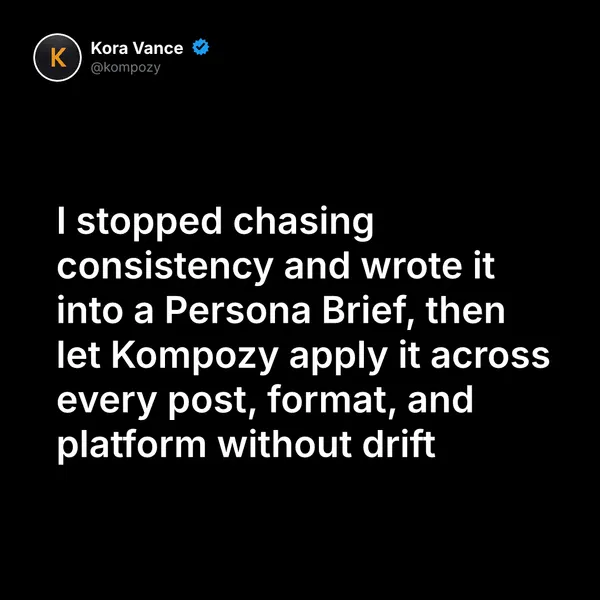
A real quote graphic generated in the Kompozy workspace. Short, specific social posts like this restate a business's details in a form Google's AI can read and quote.
Who is this for, and who should skip it?
Best for:
- Local service businesses, like trades, clinics and salons, that rely on Google for calls and visits
- Owners with a solid Google Business Profile who still don't appear in AI answers
- Agencies building content plans around specific services and service areas
Not ideal for:
- Businesses without a verified, complete Google Business Profile; fix that grounding layer first
- Anyone looking for review generation or listings management, which this guide does not cover in depth
- Online-only brands with no local service area, where local grounding does not apply
Frequently asked questions
How do local businesses show up in Google's AI search experiences?
Through two layers. First, the entity Google grounds on — your Google Business Profile and the Maps data behind it, which Google treats as an authoritative local source. Second, the open web Google synthesizes and cites on top of that profile: your website, posts, reviews, and social content. A clean, complete profile makes Google confident who you are; specific, corroborating web and social content gives its AI answer something concrete to quote you for. You need both — the profile alone rarely earns a mention when a competitor's content answers the question more specifically.
What is the difference between the local map pack and a Google AI Overview?
The map pack is a ranked list — Google shows a set of local businesses and a few more a click away. A Google AI Overview or AI Mode answer is a synthesized recommendation that names only one or two businesses directly, drawing on profile data, reviews, and web content, and it increasingly appears above or instead of the pack. Because the AI answer names so few businesses, ranking in the pack no longer guarantees you are in the AI answer — it is a separate objective.
Does Google AI Mode use my Google Business Profile?
Yes. Google's local answers are grounded in Maps and Google Business Profile data — Google made this a formal capability when Grounding with Google Maps, covering over 250 million places, reached general availability on September 26, 2025. AI surfaces favor complete, active profiles: accurate hours, services, categories, photos, a real description, and steady reviews with owner responses. But the profile is the grounding layer, not the whole answer; the web and social content Google synthesizes on top is what usually decides which business gets named.
Do Google AI Overviews cite social media for local businesses?
Increasingly, yes. 2026 research found Google AI Overviews citing Facebook, Instagram, and TikTok millions of times, making social posts a real source AI answers pull from. For a local business that means a consistent social presence describing your services, area, and specifics is another surface Google's AI can corroborate you from — and one most local operators leave empty. It is not a substitute for a strong profile and site, but it widens the set of places Google can find a specific, quotable answer about you.
How does Kompozy help a local business get visible in Google AI search?
Kompozy is an AI content generation and multi-platform publishing engine, and its role is the second layer — the open-web-and-social content Google synthesizes on top of your profile. You cannot edit Google's Maps grounding, but you own everything Google reads around it. From one brief Kompozy generates a specific answer for each service and area — blog articles, posts, carousels, and short-form video — governed by one Persona Brief so your name, hours, and positioning stay identical everywhere, then publishes them on a recurring cadence behind a review gate. It does not manage your profile or reviews; it removes the content-volume ceiling that leaves most local businesses with nothing specific for Google's AI to quote.
How do we know this?
On 2026-10-23 we checked the dates and figures on this page against Google's Developers Blog announcement of Grounding with Google Maps, Google's I/O 2026 Search post and Mezha's report of BrightEdge's July 2026 study. We removed comparisons and rankings of source types we could not trace to a study. Kompozy details come from kompozy.io/pricing.
Sources
- Google Developers Blog — Your AI is now a local expert: Grounding with Google Maps is now GA (read 2026-10-23)
- Google — Search updates from I/O 2026 (read 2026-10-23)
- Mezha — Google AI Overviews rely on social media (BrightEdge study) (read 2026-10-23)
- Kompozy — Pricing (read 2026-10-23)
Get started → · ← All guides · Compare Kompozy vs other tools