The social media workflow in 2026: how the idea-to-published pipeline got rebuilt — and the two stages where it still breaks
For most of the last decade a social media workflow was a relay: a copywriter drafted, a designer made the visual, a manager reviewed, an approver signed off, and a scheduler queued it — each handoff a separate person, a separate tool, and a separate place the whole thing could stall. In 2026 that relay has been rebuilt from the inside. AI collapsed the middle of the workflow: the drafting, the design, the per-platform reformatting, even the first pass of reporting are now things a model does in seconds, which means the bottleneck moved. It is no longer 'how do we make enough content' — a governed engine can generate a month in an afternoon — it is 'how does all that content get reviewed, approved, and published without the two human-owned stages at either end becoming the new jam.' This guide is the anatomy of the modern workflow: the stages a post still passes through, what genuinely changed and what did not, where AI belongs and where accountability has to stay with a person, why tool consolidation quietly matters more than any single feature, and the two stages — approval and the handoff to publish — where even a fast, AI-heavy pipeline still breaks in practice.
Published 2026-09-10 · Updated
Short answer
A social media workflow is the set route a post takes from idea to published: ideation, creation, review, approval, scheduling, publishing and monitoring, with a named owner at each stage. In 2026, AI shrank the creation stages from days to minutes. That moved the bottleneck to the two human ends, the approval gate and the handoff to publishing, and to the gaps between separate tools.
Key takeaways
- The stages barely changed; how long each one takes changed a lot.
- AI now handles drafting, design, per-platform resizing and first-pass reporting.
- Approval is the throughput bottleneck, so keep it to the fewest reviewers, in parallel, with deadlines.
- Exporting and re-uploading between tools is where approved posts stall.
- Keep a person accountable for approval and for live community replies.
What is a social media workflow?
A social media workflow is the fixed, repeatable route a piece of content travels from idea to live, with a named owner and a defined handoff at every step. It sits underneath your strategy (what to post and why) and your calendar (when each slot goes out) and is easy to ignore right up until it fails — a post dies in someone's drafts, a wrong claim ships because nobody reviewed it, an approver goes on holiday and the whole queue backs up behind them. The workflow is the plumbing, and like plumbing you only notice it when it leaks.
For most of the last decade that plumbing had a settled shape: a relay of specialists. A copywriter drafted, a designer built the visual, an editor tightened it, a manager reviewed, an approver signed off, a scheduler queued it, and a community manager watched the replies. Each handoff was a separate person, often a separate tool, and always a separate place the whole thing could stall. The work was linear and slow, and the scarce resource was production capacity — making enough good content was the hard part.
2026 broke that assumption, and it broke it from the middle out. AI did not replace the workflow; it collapsed its center. The drafting, the design, the per-platform reformatting, and even the first pass of reporting are now things a model does in seconds rather than stages a specialist owns for hours. This is not a fringe practice; it is the default way the middle of the workflow now runs. And when the middle compresses from days to minutes, the bottleneck does not disappear. It moves.
What changed in social media workflows in 2026?
The stages of the workflow barely changed. A post in 2026 still passes through ideation, creation, review, revision, approval, scheduling, publishing, and post-publish monitoring — the same spine a team would have recognized in 2018. What changed is the time and cost profile of each stage, and that shift is dramatic enough to reorganize everything around it.
The creation stages compressed the most. What used to be the slow, expensive part — writing the copy, producing the visual, cutting the video, adapting the asset for each platform — is now the fast, cheap part. That inverts the old economics: production capacity is no longer the constraint. A governed engine can generate a month of content in an afternoon, so 'make enough' stopped being the hard problem for anyone willing to run the tools.
The stages that did not compress are the human-owned ones at either end. Ideation still needs a real point of view and a real source — a model produces confident, sourceless filler when it has neither. And review, approval, and community management still need human judgment: someone has to confirm a stat is right, a line is on-brand, a claim is legally safe, and a required AI disclosure is present, and someone has to answer the actual humans in the replies. Those stages take about as long as they always did. So the workflow that used to be slow in the middle and fast at the ends is now fast in the middle and slow at the ends — which is the whole story of what 2026 did to it.
What are the stages of a modern social media workflow?
A modern social media workflow has the same seven or eight stages, but it is worth walking them with the new time profile in mind, because that is what tells you where to put your attention.
Ideation and sourcing — still human, still the anchor
Every reliable workflow starts from real raw material, not a blank prompt box: a long-form video or podcast, a talk, a blog post, customer questions, your own reporting. This is the authorship anchor the rest of the pipeline produces around. AI can help surface angles and trends, but the original idea and the source are what keep the output from being generic — and they are the one input a model genuinely cannot manufacture for you.
Creation and per-platform adaptation — the stage AI rebuilt
This is where the compression happened. From a single source, the modern workflow generates the core asset and its platform-native variants — vertical clips, a carousel of the key points, quote graphics, a text post, a blog cut-down, a newsletter section — each restructured for how people consume that surface rather than cross-posted identically. The skill here shifted from 'can you produce it' to 'can you keep it on-brand at volume,' which is a governance problem, covered below.
Review and approval — now the throughput bottleneck
When creation was slow, approval felt fast by comparison. Now that creation is instant, approval is the stage that determines how much actually ships. The design principle that separates a working gate from a broken one is restraint: limit reviewers to people who genuinely catch a brand, legal, or accuracy problem a creator would miss, set a deadline for each review, and run multiple stakeholders in parallel rather than in a chain. For agencies, a client-approval step sits between internal review and scheduling — and it is the single most common place a queue backs up. The operational mechanics of getting this right are in how to build a social media workflow.
Scheduling, publishing, and monitoring — the handoff that still leaks
Approved content gets queued, published across platforms at sensible windows, and then watched. Scheduling is a solved, commoditized capability, but the handoff from 'approved' to 'live everywhere' is still where a batch stalls if it means exporting from one tool and re-uploading into another. And the workflow does not end at publish: monitoring, community replies, and reactive ad-hoc posts are a standing human-owned stage no schedule covers.
Where does AI belong in a social media workflow?
The durable division of labor in a 2026 workflow is easy to state and worth stating plainly: AI does the production, a human owns the decision. AI belongs in ideation support, first-draft copy and visuals, per-platform reformatting, scheduling recommendations, message triage, and reporting — the high-volume, low-judgment work in the middle of the pipeline. Accountability belongs to a person at the approval gate and in real-time community management, the two places where judgment and risk concentrate.
This is not a soft preference. It is enforced by the platforms. In July 2026 alone, Snapchat stopped recommending wholly AI-generated Spotlight videos and LinkedIn added a report button that feeds its AI-slop classifiers, so the platforms are enforcing this through ranking, not just policy pages — the full picture is in the guide on social media automation in 2026. A workflow that removes the human review step does not just risk an off-brand post; it risks shipping the exact low-effort signature those systems are tuned to suppress, and it accumulates AI-disclosure compliance risk with every post. The approval gate is the single feature that converts an AI-heavy workflow from a liability into an asset, because it is where a person confirms tone, accuracy, and disclosure before anything reaches an audience.
Why does tool consolidation matter more than any feature?
In the old relay workflow, the handoffs between people were the risk. In the new AI workflow, the handoffs between tools are the risk. When your workflow spans an LLM for copy, a design tool for carousels, a video app for shorts, a stock library for b-roll, a scheduler for the calendar, and a dashboard for analytics, every seam between those six tools is a place the batch stalls and the brand voice drifts. You solved the production bottleneck and rebuilt it as an integration bottleneck.
That is why consolidation matters more than any single capability. A workflow running through fewer, deeper tools has fewer seams to leak at — the voice specification carries across every format because it lives in one place, the assets do not get re-exported and re-uploaded between stages, and the approval and publish steps are not separated by a manual handoff. The 2026 advantage is not owned by the team with the most tools; it is owned by the team whose create-through-publish stages live in the fewest. This is the same lesson the broader shift to AI content creation in 2026 keeps surfacing: the leverage is in the system, not the individual model.
Where does a social media workflow still break?
Put the compression and the consolidation problem together and you can name exactly where a modern, AI-heavy social workflow fails in practice. It is not the creation stage — that is the part AI fixed. It is the two stages on either side of it: the approval gate and the handoff to publish.
Approval breaks when the workflow got faster at making content but not at reviewing it. A pipeline that generates forty posts a week and routes them through a five-person sign-off chain over email has simply moved the traffic jam downstream. The fix is design, not more speed: the fewest reviewers who actually catch something, a deadline on each review, parallel rather than serial sign-off, and a single tracked surface where approvals are visible and auditable instead of buried in DMs no one can reconstruct later.
The publish handoff breaks when 'approved' and 'live' are in different tools. If a person has to export an approved batch from wherever it was made and re-upload it into a scheduler, that manual step is where content sits, gets forgotten, or ships with the wrong asset because a media file expired between systems. The fix is for approval and publishing to be the same system, so an approved post flows to scheduled without a human carrying it across a seam. These are the two stages a workflow audit should scrutinize first, because they are where throughput is actually lost.
Where does Kompozy fit in the workflow?
Kompozy is built for the two stages this guide identifies as the modern failure points, and it is deliberately not built to be the human ends. It is a full generation-and-publishing engine — not a scheduler with an AI button — which matters because the value in 2026 lives in collapsing the create-through-publish middle into one system rather than a relay of six tools with a leaking seam at every handoff.
The consolidation is the point. From a single source or brief, Kompozy generates the 20 output formats a modern channel needs — Persona Shorts and other avatar and clipped video, Photo Posts, Carousels, Quote Graphics, Text Posts, Blog Articles, and Email Newsletters — using Claude and OpenAI for copy, gpt-image for images, Gemini face-lock for consistent persona images, and HeyGen for avatar video. Because every output is written against one Persona Brief and rendered brand-consistent through HyperFrames, the voice and the look hold across a month of content the way they hold across the first three posts — which is the governance layer that keeps 'on-brand at volume' from being the stage that breaks.
Then the two stages that actually leak are one system, not a handoff. The approval gate is the pipeline's default: every generated post lands in a per-post review state, and nothing publishes until a human approves, edits, or kills it — an auditable, single-surface sign-off rather than sign-offs scattered across email. And the publish handoff does not exist as a separate step, because autopilot schedules and fans the approved queue across 9 social platforms plus blog and email from the same place the content was made and approved. There is no export-and-re-upload seam for content to fall through. The honest boundary: Kompozy runs the create-through-publish middle, not the human ends — it does not set your strategy, supply your ideation or source material, or handle real-time community replies, which stay the human-owned stages on purpose. What it removes is the tool-sprawl and the two handoffs where a 2026 workflow otherwise stalls.
Did AI change the stages of the social media workflow?
The social media workflow in 2026 has the same stages it always did, but a completely different center of gravity. AI collapsed the creation stages from the slow, expensive part into the fast, cheap part, which inverted the old economics: production is no longer the constraint. The constraint moved to the two human-owned ends — the approval gate and the handoff to publish — and to the seams between the many tools a fast pipeline tends to sprawl across. The teams that ship consistently are not the ones with the most AI tools or the fastest generator; they are the ones who governed the output with a real voice specification, kept a human at the approval gate, and consolidated the create-through-publish stages so the handoffs stopped being where content dies. Fast in the middle is table stakes now. Reliable at the ends is the whole game.
What does this look like in Kompozy?
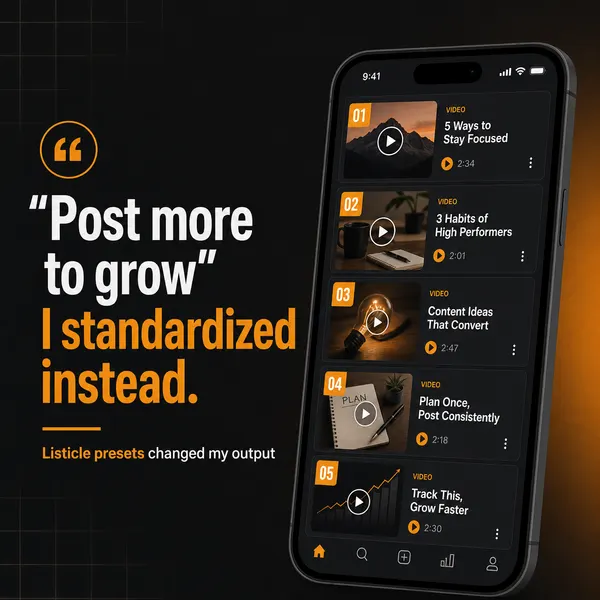
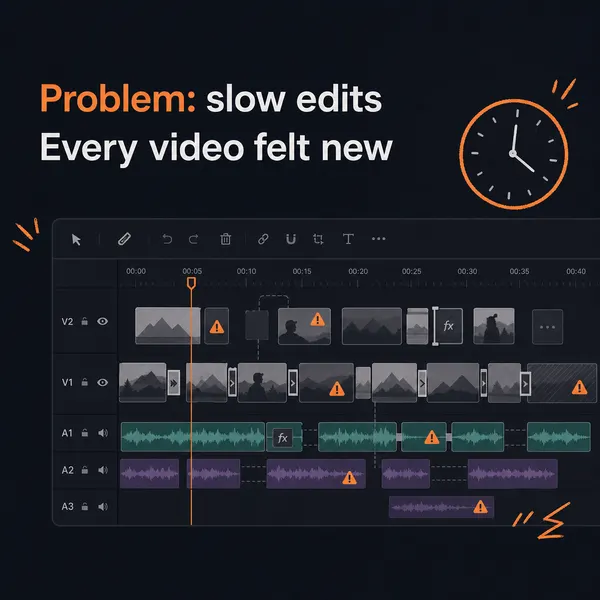
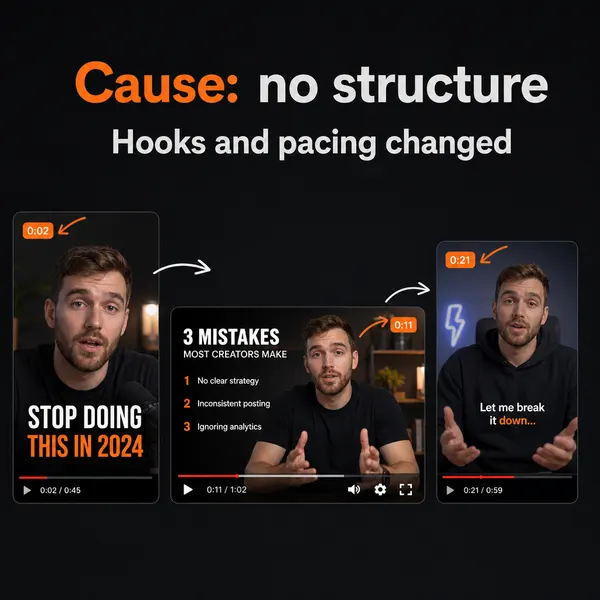
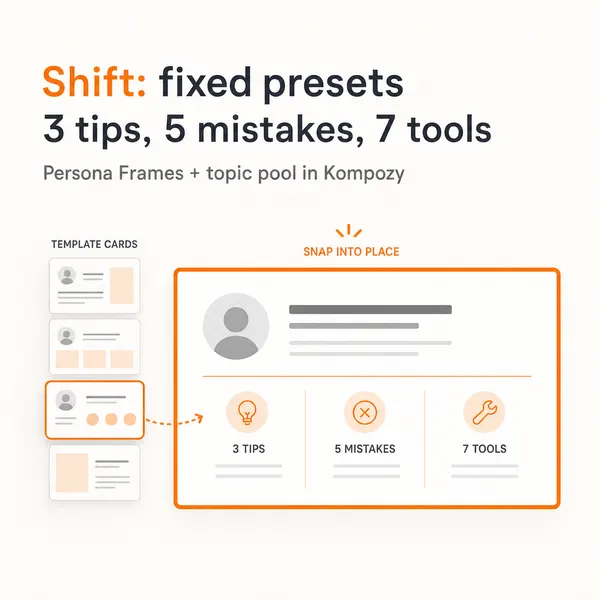
A real carousel from the Kompozy workspace. Posts like it wait in a per-post review state until someone approves, edits or rejects them.

Who is this for, and who should skip it?
Best for:
- Teams producing more content than their approval process can handle
- Agencies with a client-approval step that keeps backing up
- Teams running copy, design, video and scheduling in separate tools
Not ideal for:
- Solo creators posting a few times a week with no review step to speed up
- Teams that want to remove human review entirely, which platforms now penalize
- Anyone looking for a tool to handle live replies and DMs; that stays a human job
Frequently asked questions
What is a social media workflow in 2026?
It is the defined route a post travels from idea to published — ideation, creation, review, approval, scheduling, publishing, and post-publish monitoring — with a named owner at each stage. What changed in 2026 is that AI now handles most of the creation stages, so the workflow is less about producing enough content and more about governing it: reviewing, approving, and distributing an output volume a small team could never have made by hand before.
How has AI changed the social media workflow?
AI collapsed the middle stages. Drafting copy, generating images and video, reformatting per platform, and first-pass reporting used to be separate specialists and separate tools; a governed engine now does them in one step. That moves the bottleneck to the ends of the workflow — the human-owned approval gate and the handoff to publish — and shifts the scarce skill from production speed to judgment, voice, and quality control.
What stages does a modern social media workflow have?
A common spine is ideate, create, review, revise, approve, schedule, publish, then monitor and engage. Agencies add a client-approval step between internal review and scheduling. The stages themselves barely changed from the pre-AI era; what changed is that the create stage compressed from days to minutes, which is why the review and approval stages are now the ones that determine throughput.
Where should humans stay accountable in an AI social media workflow?
At the approval gate and in real-time community management. AI can draft, design, reformat, and schedule, but a person must confirm tone, accuracy, brand fit, and any required AI disclosure before anything ships, and a person must handle live replies, DMs, and crisis response. The reliable 2026 pattern is AI-heavy production with a human-owned decision on what actually goes out and how the brand shows up in conversation.
Why does tool consolidation matter for a social media workflow?
Because every handoff between a separate writing tool, design tool, video app, scheduler, and analytics dashboard is a place the batch stalls and the brand voice drifts. When the workflow spans six tools, the seams between them become the workflow's failure points. Consolidating the create-through-publish stages into one engine removes those seams — which is exactly why the 2026 advantage sits with teams running fewer, deeper tools rather than a longer chain of point solutions.
How do we know this?
We checked every figure and named fact on this page against the sources listed below on 2026-10-23, and removed or rewrote anything we could not confirm. Platform enforcement examples come from TechCrunch's report on Snapchat and Let's Data Science's report on LinkedIn. Kompozy product details come from kompozy.io.
Sources
- TechCrunch — Snapchat no longer rewards fully AI-generated Spotlight content (read 2026-10-23)
- Let's Data Science — LinkedIn adds AI slop reporting option (read 2026-10-23)
- Kompozy — homepage (formats, 9 platforms, review gate) (read 2026-10-23)
Get started → · ← All guides · Compare Kompozy vs other tools