What Wikipedia reveals about AI Overviews and web traffic: the cleanest signal we have on what AI answers do to the click (2026)
Almost every write-up on AI Overviews and traffic decline leans on the same commercial sites — blogs, news, affiliate pages — whose numbers are tangled up with algorithm updates, monetization changes, and their own SEO games. Wikipedia is the cleaner test. It sits at or near the top of the results for a huge share of informational queries, it is among the sources Google's AI summaries cite most often, it does not chase rankings for money, and it publishes its own traffic data openly. So when Wikipedia's human traffic falls, you are watching close to a pure read on what happens to the click when an AI answer sits above the link. In October 2025 the Wikimedia Foundation reported roughly an 8% year-over-year drop in human pageviews and tied it to generative AI and social video — with an important caveat about a bot-detection correction that this page does not gloss over. A separate University of Washington working paper tried to isolate AI Overviews specifically and estimated they cut Wikipedia's search referrals by about 5%, on the order of 1.2 billion fewer visits a year for the English edition alone. This guide walks the verified numbers honestly, explains why Wikipedia is the canary the whole web should be watching, and draws out the one lesson that applies to every site: being the source the AI answer cites no longer guarantees the visit — so the strategy has to change from earning the click to earning the citation and owning the channels the answer can't intercept.
Published 2026-09-12 · Updated
Short answer
Wikipedia is the cleanest test of what Google's AI Overviews do to web traffic, because it ranks for most informational queries and is among the sources AI summaries cite most. The Wikimedia Foundation reported human pageviews down about 8% in 2025, partly a bot-detection correction. A University of Washington working paper estimated AI Overviews cut English Wikipedia's search referrals by about 5%, roughly 100 million a month.
Key takeaways
- Wikimedia reported an 8% drop in human pageviews in 2025, after reclassifying bot traffic.
- A University of Washington working paper puts the AI Overviews effect at about 5% of search referrals.
- Pew found users clicked a result in 8% of visits with an AI summary versus 15% without.
- Being the cited source no longer guarantees the visit.
- Earn the citation, and build email, social, and video channels an answer box cannot intercept.
Why is most AI Overviews traffic data so noisy?
Most of the evidence on AI Overviews and web traffic comes from commercial sites, and it is noisy by nature — a blog's decline is tangled up with core algorithm updates, ad-layout changes, seasonal demand, and whatever SEO tactics it was running. Wikipedia is the exception, and that is why its numbers are worth more than another affiliate site's dashboard. It ranks at or near the top for a vast share of informational queries, it is among the sources Google's AI summaries cite most often, it does not optimize for money, and it publishes its own traffic openly. When Wikipedia's human traffic falls, you are looking at about as clean a read as exists on what happens to the click when an AI answer sits above the link.
Here is what it shows, stated honestly. The Wikimedia Foundation reported roughly an 8% year-over-year drop in human pageviews in 2025 and tied it to generative AI and social video — though part of that figure is a bot-detection correction, not a behavior change, and this page does not pretend otherwise. A University of Washington working paper that tried to isolate AI Overviews specifically estimated they cut Wikipedia's search referrals by about 5%, on the order of 1.2 billion fewer visits a year for the English edition. The single lesson underneath both numbers is the one that matters for your site: Wikipedia is the content AI answers are built from, and it still loses the visit. Being the source the AI cites is no longer the same as being visited.
Why is Wikipedia the best test case for AI Overviews?
Every attempt to measure what AI Overviews do to traffic runs into the same problem: confounders. A publisher that lost a big share of its clicks in a year cannot cleanly say how much was AI Overviews, how much was a March core update, how much was a redesign, and how much was the niche simply cooling off. The broad-strokes numbers are still useful — Pew found people click a result about 8% of the time when an AI summary is present versus 15% when it is not, and the CTR compression on informational queries has been measured repeatedly (the range is laid out in AI Overviews are reducing organic clicks) — but none of those isolate a single site's cause.
Wikipedia removes most of that noise. It is not fighting for commercial rankings, so it is not gaming or being penalized by the updates that whipsaw affiliate sites. Its content is stable and comprehensive, so a query's answer does not swing month to month on its side. It sits at the informational core of search — the exact query type AI Overviews trigger on most — which means if AI answers intercept clicks anywhere, they intercept them here first and hardest. And crucially, Wikipedia is usually the thing the AI Overview is summarizing: Google's answer often restates a Wikipedia paragraph and never sends the reader to the page it lifted it from. That makes Wikipedia both the source and the victim in the same query, which is precisely why its traffic trend is the cleanest signal the open web has.
How much traffic has Wikipedia lost?
On October 17, 2025, in a post on the Wikimedia Foundation's Diff blog, Marshall Miller reported that human pageviews to Wikipedia were down roughly 8% compared with the same months in 2024. The Foundation attributed the decline to "the impact of generative AI and social media on how people seek information, especially with search engines providing answers directly to searchers, often based on Wikipedia content" — a rare case of a top-ranked source naming AI answers, by name, as the thing taking its clicks.
The honest caveat, which many recaps skipped, is how the 8% surfaced. Wikipedia updated its bot-detection systems in 2025 after noticing unusually high traffic — much of it out of Brazil during May and June — that turned out to come from bots built to look human. Once that traffic was reclassified out of the human count, the real decline in human visits became visible. So the 8% is partly a data-quality correction and partly a genuine behavioral drop; it is not a clean measurement of AI Overviews alone. Reporting it as "AI Overviews cut Wikipedia traffic 8%" overstates what the number proves. What it does establish is direction and order of magnitude, from the site with the least reason to spin it.
What did the University of Washington study find?
A separate line of evidence tries to isolate AI Overviews specifically. A working paper by Mehrzad Khosravi and Hema Yoganarasimhan — "Impact of AI Search Summaries on Website Traffic: Evidence from Google AI Overviews and Wikipedia," posted on arXiv — exploits the fact that AI Overviews rolled out on a staggered geographic and by-language schedule, using Wikipedia's multilingual structure to build a natural experiment. The latest revisions estimate that AI Overviews reduced Wikipedia's search referrals by about 5%, which for the English edition works out to roughly 100 million fewer referrals a month and about 1.2 billion a year.
Two things keep this honest. First, the paper is a working paper, not yet peer-reviewed, and its own estimate has moved as the methodology tightened — an earlier version using daily pageviews reported a much larger decline before the authors switched to monthly search referrals and added control languages. Second, Google disputes whether a combined referral metric can cleanly isolate its feature at all. Take the ~5% as the best available causal estimate rather than a settled fact. But notice that it sits below the raw 8% for a reason that is itself instructive: once you strip out bot reclassification and other confounders, the AI-Overviews-specific effect is smaller than the headline — real, measurable, and directionally certain, but not the apocalypse the biggest numbers imply. Both figures point the same way; the 5% is the one to quote if you want to be careful.
What does Wikipedia's traffic loss mean for other sites?
The reason Wikipedia's data is worth studying is not schadenfreude; it is that Wikipedia is the purest version of a position most content sites are moving toward. Its whole value proposition is being the definitive answer to an informational question — and that is exactly the value AI Overviews now deliver in place, from Wikipedia's own text, without the visit. If the site whose content literally feeds the AI answer cannot hold its traffic, no informational or explainer content can assume the ranking will keep converting to a click. The mechanism is not that your content stopped being good; it is that the click became optional, and for a growing share of queries the reader's need is met before your page loads. This is the same structural shift documented for commercial publishers in the publisher traffic collapse and, more pointedly, in the Reddit case — a site Google elevated, licensed, and cites heavily, still watching referrals turn volatile. Wikipedia is the same lesson without the commercial confounders.
The corollary is the useful part. If being cited no longer guarantees a visit, then two things are worth more than they used to be. Being the source the AI answer draws from — because a citation, even without a click, still shapes what the reader believes and occasionally does earn a visit for the deeper detail — and owning channels the AI answer cannot sit in front of. An email in an inbox, a video in a feed, a post a follower already chose to see: none of these are queries an Overview can intercept. The strategy the Wikipedia data forces is not "rank harder." It is to earn the citation on the surfaces AI answers pull from, and to build distribution on the surfaces where there is no answer box between you and the reader.
Which two responses to AI Overviews hold up?
First, become the source the answer cites. AI Overviews and the standalone answer engines prefer content they can lift cleanly: a direct answer up front, question-shaped headings, short factual paragraphs, and specifics stated plainly enough to quote in isolation. Wikipedia is structured almost perfectly for this, which is exactly why it gets summarized so often — the irony is that its citability is what lets Google answer without sending the click. You cannot avoid that trade, but you can win the citation instead of a competitor, and a citation carries brand and authority even when it does not carry a visit. The format-level mechanics are in the content formats that actually get cited and the broader levers in AI search citation optimization. One under-used amplifier: corroboration across surfaces. AI answers increasingly pull from social and video, not just articles — Pew found YouTube and Reddit next to Wikipedia among the most-cited sources in Google's AI summaries (see Google AI Overviews and social media sources) — so the same claim restated across your blog, your posts, and a video makes the model more confident it is true and more likely to name you.
Second, build the channels the answer cannot intercept. This is where the Wikipedia analogy breaks in your favor: Wikipedia has no email list, no social following it monetizes, no video presence to speak of — it is almost purely dependent on the search click, which is why the decline hits it so directly. A business is not that constrained. Email reaches an inbox with no algorithm and no answer box in the way; short-form video and social posts reach people who already follow you; a newsletter is the one distribution channel where the relationship is genuinely owned. The move the data recommends is to stop treating those as afterthoughts to an SEO program and start treating the SEO content as the citation surface while the owned channels carry the traffic and conversion. The conversion mechanics of that shift are worked through in the zero-click conversion strategy, and how to even see your AI visibility when there is no click to count is in AI search impressions in Google.
Where does Kompozy fit?
Kompozy cannot stop Google from summarizing your content in an AI Overview, and nothing can — that is a decision Google makes, and the Wikipedia data is proof that even the most-cited source on the web cannot opt out. What Kompozy addresses is the response the data actually recommends: producing the citable source content and the owned-channel distribution at a volume that makes the two-front strategy real rather than aspirational. Most sites know they should be publishing extractable answers and building an email-plus-social footprint; the reason they don't is that doing both, on a steady cadence, is more production than a small team can sustain.
Kompozy is a full AI content generation and multi-platform publishing engine — 20 output formats across nine social platforms plus blog and email — driven by one Persona Brief that fixes your voice, claims, and positioning so everything says the same thing. From a single source it generates the two halves the Wikipedia lesson calls for at once: a structured, extractable blog article built to be the paragraph an AI Overview quotes, and the same message restated as text posts, Quote Graphics, Carousel Posts, and a talking-head Persona Short for the social and video surfaces those answers increasingly cite — HyperFrames keeping every piece brand-exact. That is corroboration across surfaces done in one pass instead of five separate workflows, which is what makes an AI model confident enough to name you as the source.
The other half is the distribution Wikipedia lacks. Kompozy generates an email newsletter from the same brief — the channel no answer box can intercept — and Autopilot schedules and publishes the whole spread across the supported platforms plus blog and email from one queue, behind a per-post review gate so a person signs off before anything ships. The realistic framing: this will not claw back the search clicks an AI Overview absorbs, and it will not make Google cite you — no tool can promise that. What it removes is the production ceiling that keeps most businesses stuck defending a single search channel that the Wikipedia numbers say is structurally shrinking. You get to run the citation-and-owned-channels strategy the data recommends without hiring the team it would normally require.
What is the clearest lesson from the Wikipedia data?
Wikipedia is the clearest window we have onto AI Overviews and web traffic because it is the source the answers are made from and it still loses the visit. The verified read is a roughly 8% human-pageview decline the Wikimedia Foundation tied to generative AI and social video — carrying a bot-detection caveat that keeps it from being a clean AI-only figure — and a University of Washington working-paper estimate that AI Overviews specifically cut Wikipedia's search referrals about 5%, near 1.2 billion a year for the English edition. Both say the same thing at different precisions: the click is becoming optional even for the web's most-cited page. The response the data supports is not to rank harder for a shrinking click. It is to earn the citation on the surfaces AI answers draw from, and to own the channels — email, social, video — where no answer box stands between you and the reader. For the operating framework behind that pivot, read GEO content strategy for AI Overviews.
What does this look like in Kompozy?
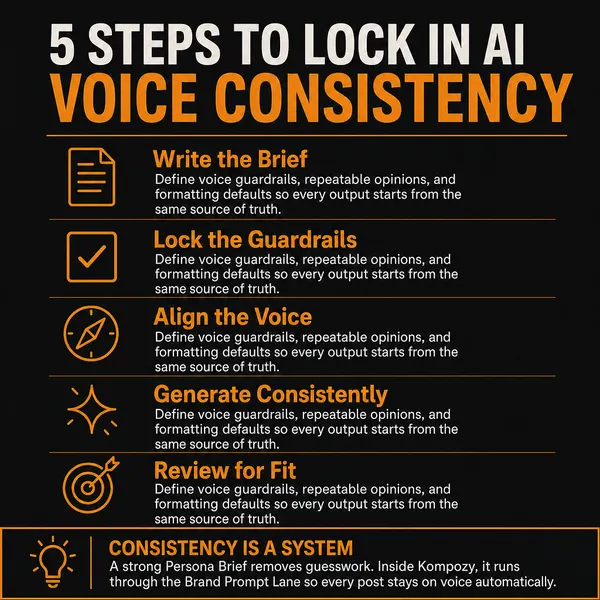
A real infographic photo post generated in the Kompozy workspace. It shows how one claim can be restated as a social post alongside the article it came from.
Who is this for, and who should skip it?
Best for:
- Publishers and content teams trying to separate AI Overviews loss from other causes.
- Informational sites deciding how far to shift into owned channels.
- Marketers who need careful numbers on AI search and traffic.
Not ideal for:
- Anyone looking for a way to stop Google from summarizing their pages. There isn't one.
- Transactional sites whose queries rarely trigger AI Overviews.
- Readers who need peer-reviewed proof. The UW study is still a working paper.
Frequently asked questions
How much traffic has Wikipedia lost to AI Overviews?
Two figures matter and they measure different things. In October 2025 the Wikimedia Foundation reported roughly an 8% year-over-year decline in human pageviews, attributing it to generative AI and social video — but that number partly reflects a bot-detection correction, so it is not a pure AI-Overviews effect. A separate University of Washington working paper tried to isolate AI Overviews using their staggered rollout and estimated they cut Wikipedia's search referrals by about 5%, on the order of 100 million fewer per month and 1.2 billion a year for the English edition. Both point the same direction; the 5% is the cleaner causal estimate.
Why is Wikipedia a good test case for AI Overviews and web traffic?
Because it strips out the noise that muddies commercial sites. Wikipedia ranks at or near the top for an enormous share of informational queries, it is among the most-cited sources in Google's AI summaries, it does not chase rankings for revenue, and it publishes its own traffic openly. Most sites' declines are tangled with core updates, monetization changes, and their own SEO tactics; Wikipedia's are not, so its numbers come as close as any public data does to a clean read on what an AI answer above the link does to the click.
Does the 8% Wikipedia decline prove AI Overviews caused it?
No, and honest reporting has to say so. The Wikimedia Foundation's 8% figure was surfaced after it updated its bot-detection systems and reclassified months of traffic — mostly a spike out of Brazil — that had been miscounted as human, so part of the drop is a data correction rather than a behavior change. The Foundation attributes the underlying decline to generative AI and social video, and the University of Washington study's ~5% referral estimate isolates AI Overviews more cleanly, but neither is a peer-reviewed causal proof. Treat the direction as well-supported and the exact magnitude as contested.
If Wikipedia loses traffic even though AI cites it, what hope does my site have?
That is exactly the lesson, and it reframes the goal. Wikipedia's content is what feeds many AI answers, and it still loses the visit — which means being the cited source is no longer the same as being visited. The response is two-part: make your content the thing the AI answer cites (structured, extractable, corroborated across surfaces so the model trusts it), and build presence on channels the answer cannot sit in front of — email, social feeds, short-form video — where you own the relationship instead of renting a click from Google.
How does Kompozy help when AI Overviews are intercepting clicks?
Kompozy is an AI content generation and multi-platform publishing engine. It cannot stop Google from summarizing you, but it addresses the two things Wikipedia's data says now matter: citation and owned distribution. From one Persona Brief it generates the structured, extractable answer that AI Overviews prefer to cite, plus the same message restated as social posts, short-form video, images, and an email newsletter — so you are corroborated across the surfaces AI answers pull from, and present on the channels a summary can't intercept. Autopilot schedules the whole spread behind a review gate.
How do we know this?
We checked every figure and dated claim on this page against the sources listed below on 2026-10-23, and removed or reworded anything we could not confirm. The 8% figure and Foundation quote come from the Wikimedia Diff post, the 5% estimate from the paper on arXiv (version 6) and Search Engine Journal's summary of it, and click rates and most-cited sources from Pew. Kompozy plan, format, and platform details come from kompozy.io.
Sources
- Wikimedia Diff — New user trends on Wikipedia (read 2026-10-23)
- arXiv — Impact of AI Search Summaries on Website Traffic: Evidence from Google AI Overviews and Wikipedia (read 2026-10-23)
- Search Engine Journal — What Wikipedia reveals about AI Overviews and web traffic (read 2026-10-23)
- Pew Research Center — Google users are less likely to click on links when an AI summary appears (read 2026-10-23)
- Kompozy — Pricing (read 2026-10-23)
Get started → · ← All guides · Compare Kompozy vs other tools