How to get AI to recommend your business (2026 workflow)
Get AI to recommend your business: baseline the buying prompts, publish original content that passes the swap test, chunk it, then unblock the crawlers.
Last verified · 2026-10-23 · by Moe Ameen
Published 2026-09-08 · Updated
Short answer
To get AI to recommend your business, record which brands ChatGPT, Perplexity, Gemini and Google's AI Mode name for your real buying questions today. Then publish original expertise that passes the swap test, structure each section so its answer comes first, and cover the whole customer journey. Make sure retrieval crawlers like OAI-SearchBot and PerplexityBot can reach you, and re-test the same prompts every month.
Key takeaways
- Ranking first on Google does not mean an assistant will name you. Test the buying prompts directly.
- Swap test: if a competitor's name could replace yours and the page still reads fine, it won't earn a recommendation.
- Put the answer at the top of each section so a model can lift it without the paragraphs above.
- Assistants fan one question into many sub-searches, so cover the whole journey, beyond the product page.
- Blocking "all AI bots" can lock out OAI-SearchBot and PerplexityBot, the crawlers that power live answers.
Buyers increasingly skip the list of blue links and ask ChatGPT, Perplexity, Gemini, or Google's AI Mode a buying question outright — "who is the best option for this," "what are the alternatives to that" — then act on the two or three names the model returns.
Being one of the names the assistant says is now the win, and it is a different job from ranking: a page can sit at the top of Google and never be spoken aloud by a model, because ranking rewards a page while recommendation rewards a brand the model is confident enough to name.
This is the ordered workflow for earning that confidence. You will baseline which buying questions the engines already answer and who they name, turn your genuine expertise into a citeable website foundation, pass the "swap test" so your content is not interchangeable with a competitor's, structure every section so a machine can lift a clean answer, map content across the full customer journey the model fans out into, clear the technical gates that quietly make sites invisible, then re-test and compound. Work the steps in order. For the entity-and-third-party-proof angle on the same goal, see how to get your business found in AI search.
What is the first step to get AI to recommend your business?
- Baseline the buying questions and who AI names today. Write out the real, spoken-language questions a prospect asks the moment they are ready to choose — "best [category] for [use case]", "[competitor] alternatives", "who does [service] well" — and run each through ChatGPT, Perplexity, Gemini, and Google's AI Mode. Record who gets named and which sources the engine cites. That list of prompts is your scoreboard for the whole project, and the citations reveal exactly which pages the engines already trust for your category — where your later work should aim.
- Turn your real expertise into a citeable website foundation. AI recommendations are grounded on what your own domain says, so give it substance to ground on. Publish your best knowledge — the newsletter issues, talks, and answers that already resonated — onto your website where crawlers can reach it, rather than leaving it locked in email or a PDF. A useful move is to keep the human-friendly version and add a second, AI-optimized version of the same substance with clearer question-based headings, so one page serves the reader and the machine at once.
- Pass the swap test: publish what only you can. Apply a blunt diagnostic to every page: if a reader could swap your company name for a competitor's and the content would still read fine, the model has no reason to prefer you. Replace generic, interchangeable copy with what is uniquely yours — firsthand experience of doing the work, proprietary data you gathered, specific named results and numbers, a point of view you actually hold. Draft with AI if you like, but the value has to come from you; a model will not elevate a source that adds nothing it could not generate itself.
- Chunk each section so a machine can lift the answer. Models extract self-contained passages, not whole pages, so build each section to stand alone and answer its question in its opening lines, before any elaboration. Lead with the answer — the definition, the number, the recommendation — then explain and qualify. Use question-based headings, short lists, and tables so the load-bearing claim is legible and quotable out of context. A section that only makes sense after the three paragraphs above it is hard to lift, and therefore rarely lifted.
- Map content across the full customer journey. When someone asks a buying question, the model fans it out into many hidden sub-searches — features, comparisons, mistakes to avoid, questions asked after the purchase — and names the brand it sees across the most of them. So cover the whole journey, not just the product page. Mine your support tickets and sales calls for the exact questions customers ask at every stage, and answer each as its own chunked, original piece. Breadth across the fan-outs is what pulls you into more answers and compounds into a recommendation.
- Clear the technical gates that make sites invisible. None of this counts if the answer crawlers cannot read you. Audit robots.txt so you are not blanket-blocking the retrieval agents (OAI-SearchBot, PerplexityBot, Google's crawler) while trying to block training scrapers, and check any host-level AI blocker such as Cloudflare's for the same over-block. Make sure your substance is in the served HTML rather than only rendering after heavy JavaScript, keep an XML sitemap, and add Organization, Product, FAQ, and list schema so machines can parse what the page is. See how to use schema markup to get cited by AI.
- Re-test the prompts and compound. Recommendation is a loop, not a launch. Re-run your baseline prompt list on a schedule — monthly is enough for most businesses — and chart your share of the recommendations over time. Wherever a competitor is named and you are not, open the page and sources the engine cited and close that specific gap with another original, chunked piece. Because AI answers vary run to run, read the trend across repeated tests, not any single response, and keep publishing so live retrieval keeps counting you.
What mistakes stop AI assistants from recommending a business?
- Ranking is not recommendation. A page can rank first on Google and never be named in an AI answer — measure the recommendation directly by running your buyer prompts, not by watching classic rankings.
- Generic content disqualifies itself. If your page passes the swap test — swap in a competitor's name and it still reads fine — the model has nothing specific to prefer, so it absorbs the info without naming you.
- Blocking AI crawlers by accident is common. A blanket "disallow all AI bots" rule or a host-level AI blocker locks out the retrieval agents that build live answers, not just training scrapers — the two are different decisions.
- A single perfect page rarely wins. Because the model fans one question into many, thin coverage loses to a competitor that shows up across the whole cluster of sub-questions — breadth across the journey beats one polished page.
- JavaScript-only content can be unreadable. If your substance only appears after heavy client-side rendering, a retrieval agent that does not execute your scripts sees an empty page — keep the answer in the served HTML.
- One test is noise. AI answers vary between runs, so a single check tells you little — track the same prompts repeatedly and read the trend.
Where does this workflow stall, and where does Kompozy fit?
Steps 2 through 5 are where this workflow actually gets built — and where it stalls, because they are a production job, not a decision. You have to move your best expertise onto the site, keep it passing the swap test, chunk every piece for extraction, and cover the full journey the model fans out into; do that for one buying question and it is a handful of pieces, do it for every prompt that decides a category and it is dozens, each carrying identical facts and refreshed often enough that live retrieval keeps counting you.
That throughput is exactly what Kompozy is built to produce. Kompozy is a full AI content generation and multi-platform publishing engine — 20 output formats across nine social platforms plus blog and email — not a repurposing add-on.
Feed it the raw material that passes the swap test (your firsthand expertise, your proprietary numbers, the real customer questions from step 5's support-ticket mining) under one Persona Brief, and it generates the coordinated, journey-wide set: a front-loaded, chunked Blog Article that answers a buying decision in liftable form, Carousel Posts and Quote Graphics that restate your original, load-bearing claims as discrete quotable statements, Text Posts tuned per network, and a Persona Short where your named expert makes the case on camera — every asset saying the same true thing, which is the consistency that lets a model state it as fact. Autopilot then schedules and fans the set across nine social platforms plus blog and email behind a per-post review gate, so a human signs off on accuracy — the trust discipline this whole workflow depends on — before anything ships, and one answer lands on many owned surfaces at a cadence competitors cannot match by hand.
Be clear on the boundary: Kompozy produces and publishes the owned content you control and keeps it original, chunked, and comprehensive, and it clears none of the technical gates in step 6 or earns the outside reviews and forum consensus that make up the earned half of a recommendation — do that work separately. What it removes is the throughput ceiling that keeps most businesses from ever covering enough of the journey to be named.
A solo operator planting a flag on a few buyer prompts fits Starter ($199/mo, 5,500 credits, 4 platforms); a brand contesting a whole category across every channel fits Pro ($499/mo, 18,000 credits, 9 platforms and full autopilot); Enterprise is available through Contact Sales for agencies running AI discovery for multiple clients.
What does this look like in Kompozy?
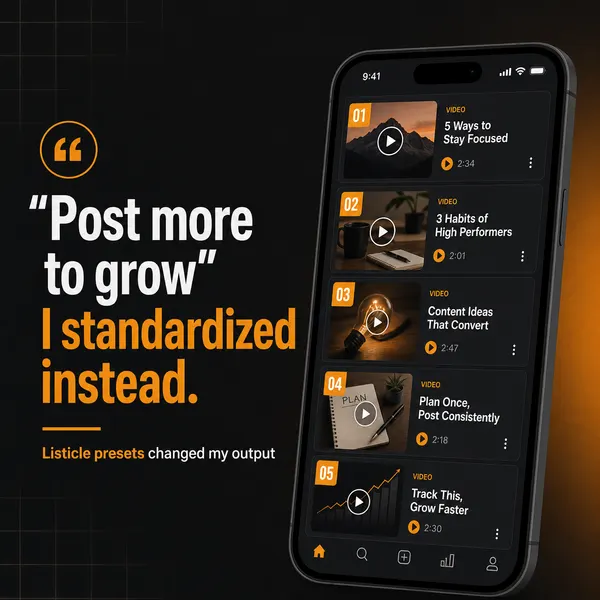
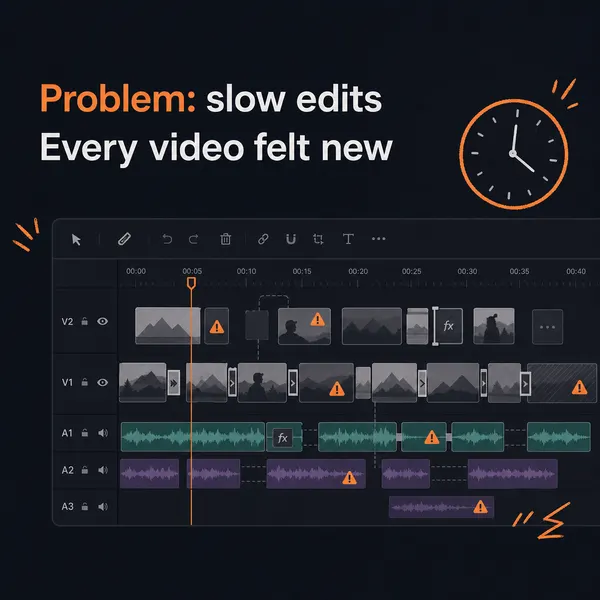
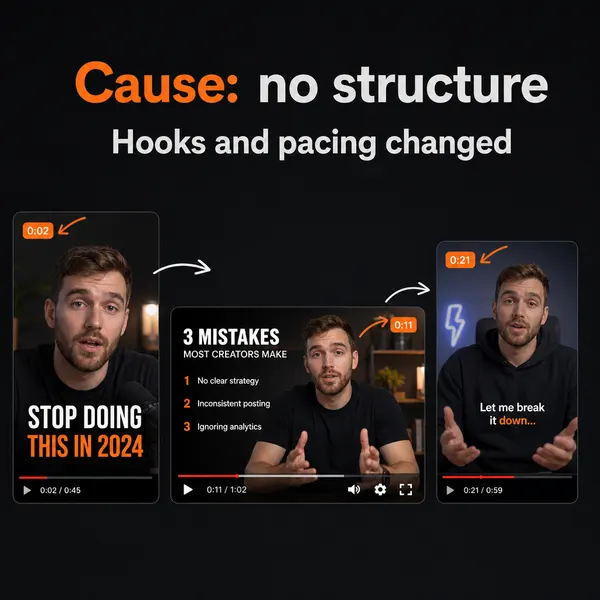
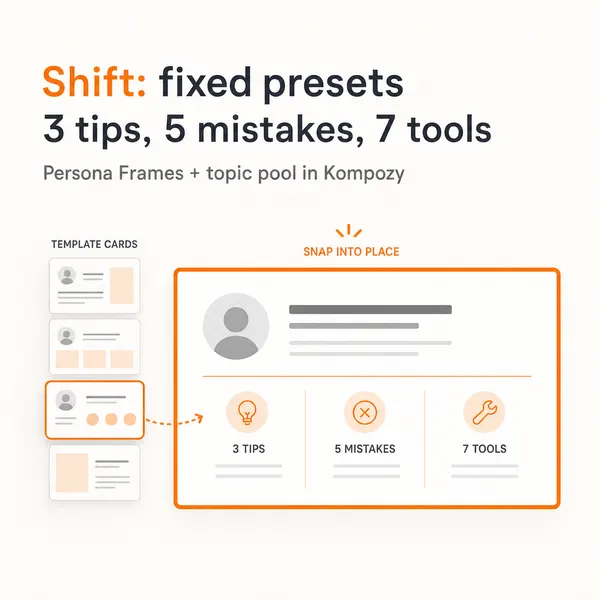
A real carousel made in the Kompozy workspace, shown as an example of the format. It was not made for this guide.
Who is this for, and who should skip it?
Best for:
- Businesses with real expertise, data or customer results they can put on their own site.
- Teams willing to re-run the same buyer prompts every month and read the trend.
- Brands that can publish across the whole buyer journey, not one product page.
Not ideal for:
- Anyone after a one-time fix. This is a publishing cadence that takes months.
- Sites whose problem is technical (robots.txt, JavaScript rendering). Kompozy does not fix those.
- Brands that need outside reviews and forum mentions. Kompozy does not earn those for you.
Frequently asked questions
How do I get ChatGPT or Perplexity to recommend my business?
Make the model confident enough to name you. Publish genuinely original content — firsthand experience, proprietary data, specific results a competitor could not re-label — structured so each section answers its question up front. Cover the full arc of buyer questions the model fans out into, not just your product page, and make sure the answer crawlers can reach and read your site. Then test the buying prompts you want to win and close the gap wherever a competitor is named instead of you.
What is the swap test?
It is a fast originality check: take one of your pages, mentally replace your company name with a competitor's, and ask whether it still reads as true and fine. If it does, your content is interchangeable, and an AI model treats interchangeable sources as interchangeable — it will not attribute the information to you. Content that passes the test contains something only you can honestly claim: your firsthand experience, your data, your specific results, your stance.
What are fan-out queries and why do they matter for this?
When you ask an assistant a question, it usually deconstructs your prompt into a set of hidden related sub-searches, retrieves sources for each, and synthesizes one answer from all of them. That is a fan-out. It matters because the model is not matching one query to one page — it names the brand it saw across the most of those sub-searches, which is why covering the full customer journey beats owning a single perfect page.
Is getting recommended by AI just SEO?
It overlaps but adds real work. Crawlable, well-structured, authoritative content helps both. What recommendation adds on top is originality that survives the swap test, passage-level structure a model can lift, coverage across the whole question cluster, and measuring the recommendation itself by running buyer prompts rather than watching rankings — which no longer predict whether a model names you.
How long before AI starts recommending my business?
Because most AI answers use live retrieval, fixes an engine can re-crawl — a clearer page, a technical unblock, a fresh original piece — can start changing what a model says within days to weeks. Building the durable breadth of original, journey-spanning coverage that holds a recommendation against competitors still shipping takes longer, on the order of months of consistent publishing. It is a cadence, not a one-time setup.
How do we know this?
On 2026-10-23 we checked the crawler names and query fan-out descriptions on this page against the sources listed below. Kompozy plan details come from kompozy.io/pricing.
Sources
- OpenAI: Overview of OpenAI crawlers (read 2026-10-23)
- Perplexity: Perplexity crawlers (read 2026-10-23)
- Google Search Central: AI features and your website (read 2026-10-23)
- Kompozy: Pricing (read 2026-10-23)
Related tutorials
- How to get your business found in AI search (2026 workflow)
- How to win citations in AI answers (2026)
- How to use schema markup to get cited by AI (2026)
- How to run a GEO content audit (2026)
- How to optimize a local business for AI search (2026)
- How to build local pages AI systems can find and trust (2026)