How to write an FAQ page that gets cited by AI search (2026)
Write an FAQ page AI search cites: mirror real questions customers ask, give each a standalone 40–60 word answer, and keep FAQ schema after rich results end.
Last verified · 2026-10-23 · by Moe Ameen
Published 2026-09-10 · Updated
Short answer
To write an FAQ page that AI search cites, use the exact questions customers ask, make each one a heading, and answer it in a short passage that names its subject and stands alone. Add a specific fact to every answer and keep the text in server-rendered HTML. Google stopped showing FAQ rich results on May 7, 2026, so build for AI citation instead.
Key takeaways
- Google stopped showing FAQ rich results for all sites on May 7, 2026.
- Keep the FAQPage markup. Google says leaving it in place causes no errors or ranking effects.
- Write each answer so it still makes sense when an engine lifts it out alone.
- A specific number or timeframe beats a vague claim to be affordable or fast.
- Answers hidden behind script or accordions may be invisible to crawlers.
An FAQ page is one of the most extractable things you can publish for AI search, because it is already shaped the way an answer engine reads: a real question paired with a direct answer. When ChatGPT, Perplexity, Gemini, or Google's AI Mode builds a response, it does not read your page top to bottom — it retrieves the passage that best matches the prompt and lifts it.
A clean question-and-answer block is that passage, pre-cut. The problem is that most FAQ pages are still written for a search feature that no longer exists instead of for the engines that now decide who gets quoted.
Be clear on what changed. Google restricted FAQ rich results to well-known government and health sites back in August 2023, and on May 7, 2026 it removed them from Search entirely, phasing out the Search Console reports and testing support through the following months. So do not build this page expecting a rich snippet in the results — that payoff is gone. Build it to be cited inside an AI answer and to answer real customer questions clearly on the page, which is where the value moved. This is the practical version for a local business or a creator: gather the exact questions people ask, write each answer to stand on its own, keep the schema even though it no longer earns a rich result, then test whether the engines actually quote you. To spread those answers across your other channels once the page is live, pair this with how to get your business found in AI search.
How do you write an FAQ page that AI search will cite?
- Collect the exact questions people actually ask. An FAQ page only gets cited when its questions match real prompts, so start from evidence, not guesswork. Pull the literal phrasings from your sales and support inbox, review text, the 'People also ask' box, autocomplete, and — most directly — from typing your buying questions into ChatGPT and Perplexity and reading what people apparently ask. Write each one down in the customer's words, not your marketing paraphrase. The closer a question is to how a real person phrases it, the more likely an engine treats your answer as the match.
- Prioritize a focused set over an exhaustive one. More questions is not better past a point — a handful of precise, distinct questions earns citations while a padded list of near-duplicates dilutes the page and adds no lift. Group your raw questions by intent (what you do, pricing, area or availability, how you compare, what to expect), drop the ones that overlap, and keep the specific over the generic: 'do you do same-day water-heater repair on weekends' beats 'what services do you offer.' A page that answers many sharp questions outperforms one that answers a couple of broad ones, because each entry is another chance to match a prompt exactly.
- Write every answer to stand completely on its own. This is the step that decides everything. An engine extracts a single answer in isolation — it does not read the question above it or the paragraph below — so any answer that says 'as mentioned above,' 'we,' or 'this' without naming the subject breaks the moment it is lifted. Restate the subject in each answer, front-load a short, direct response that fully answers the question by itself, then add supporting detail underneath for the human reader. If you could copy the answer out of context and it still makes sense, an engine can too.
- Use the question itself as the heading. Make each question a real heading (an H2 or H3) worded exactly as a customer would ask it, with the answer immediately beneath. Question-shaped headings give both crawlers and answer engines an unambiguous map of what each block answers, and they mirror the prompt an engine is trying to satisfy. Skip clever section titles — 'Pricing FAQ' tells a model nothing; 'How much does a roof inspection cost?' tells it exactly which prompt this block wins.
- Back each answer with a specific, checkable fact. Engines quote the answer that is concrete and credible, not the one that sounds confident. Put a real number, a named process, a location, a timeframe, or a specific qualifier into each answer. An answer that gives your actual inspection time and price beats 'we offer affordable, timely inspections.' Specifics also become the substance a model can match to a constrained question and repeat as fact. Vague, could-be-anyone copy is exactly what gets passed over for the competitor who wrote a real answer.
- Keep the FAQ schema — it still helps, just not the way it used to. Add FAQPage structured data mapping each question to its answer even though it no longer produces a rich result. It remains a valid Schema.org type, Google still parses it to understand the page, and it hands machines an explicit question-to-answer structure. The rich-snippet payoff is gone; the machine-readability payoff is not. If your CMS or SEO plugin outputs it automatically, leave it on — Google has said unused FAQ markup does not cause problems, so there is no reason to strip it.
- Make the answers crawlable and consistent with the rest of your site. An answer an engine cannot read cannot be cited, so make sure the FAQ content is in the server-rendered HTML — not hidden behind an accordion or tab that only paints after a click, or injected by script that a crawler never runs. Then check that the facts in your answers match what your homepage, Google Business Profile, and other pages say. When your hours, prices, service areas, or positioning disagree across surfaces, a model hedges or skips you rather than repeating a claim it cannot corroborate.
- Test with the real prompts, then keep the page fresh. Run the actual questions from step one through ChatGPT, Perplexity, Gemini, and Google's AI Mode and record whether you are cited, how you are described, and who is named instead. Every question you lose is a gap: either you have no answer for it, or a competitor's answer is more specific. Add the missing questions, sharpen the weak answers, and re-test on a cadence — live retrieval rewards pages that stay current, and a new question customers started asking last month is a citation you are not yet earning.
What FAQ page mistakes stop AI engines from citing you?
- FAQ rich results are gone as of May 7, 2026. Do not build this page for a SERP snippet that no longer appears for any site — the payoff now is AI citation and clear on-page answers, and Google is phasing out the FAQ reports in Search Console too.
- Paraphrasing the question loses the match. If customers ask 'is it safe for pets' and your heading says 'product safety information,' an engine may not connect the two — mirror the real phrasing.
- Answers that lean on the surrounding page break when extracted. 'As noted above,' 'we,' and 'this' collapse the moment an engine lifts the answer alone — restate the subject in every answer.
- Padding the page with near-duplicate questions adds no citation lift and dilutes the page. A focused set of precise, distinct questions beats an exhaustive list.
- Marketing-speak answers get skipped. Engines reach for the specific, evidenced answer — a number, a process, a timeframe — over the one that just claims to be best.
- Accordions and JS-injected FAQs can be invisible to crawlers. If the answer is not in the server-rendered HTML, confirm the engines can actually read it.
- Contradicting your other pages costs you. When an answer disagrees with your Google Business Profile or homepage, a model hedges instead of naming you — keep the facts consistent everywhere.
How do you spread your FAQ answers beyond your own site?
Treat each answer on this page as an atom, not a page section. An FAQ page answers a customer's question in one place on your own domain — but an answer engine assembles its recommendation from many surfaces, so the same question answered as a standalone unit across your blog, your social feeds, and video is what turns one on-page answer into the cross-surface corroboration a model needs before it repeats your claim. Kompozy is built to do that multiplication. Hand it one question you want to own — say, "how much does a roof inspection cost" — and from your Persona Brief it produces the coordinated Q&A set: a Blog Article that answers the full cluster of related questions in extractable, front-loaded form, Text Posts that each answer one question in that network's voice, Quote Graphics and Carousel Posts that restate the answer as discrete liftable cards, and a Persona Short where your named expert answers the top question on camera — every asset carrying the same specific facts your FAQ page states, which is exactly the consistency that lets a model name you instead of hedging. Autopilot then schedules and fans that set across the eight social platforms plus blog and email behind a per-post review gate, so one answer lands on many independent surfaces at a cadence you could not keep by hand. Be clear on the boundary: Kompozy generates and publishes the owned content you control and keeps its facts identical to your FAQ page, but it does not write the FAQPage schema onto your external site or manage your Google Business Profile — the on-page schema and listing work in steps six and seven stay yours. Kompozy's paid plans (see pricing) start with Starter, which fits a solo operator or creator turning a question list into a content footprint; Pro ($499/mo for 18,000 credits) suits a business answering a whole category across every channel; Enterprise is available through Contact Sales for agencies running AI-answer coverage for multiple clients.
What does this look like in Kompozy?
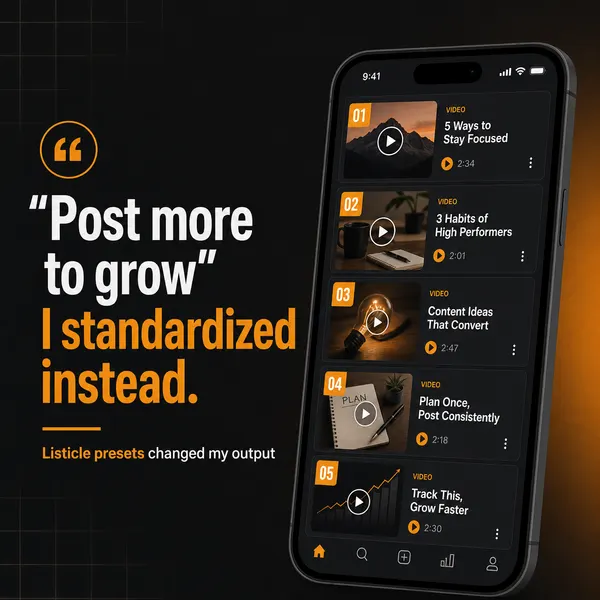
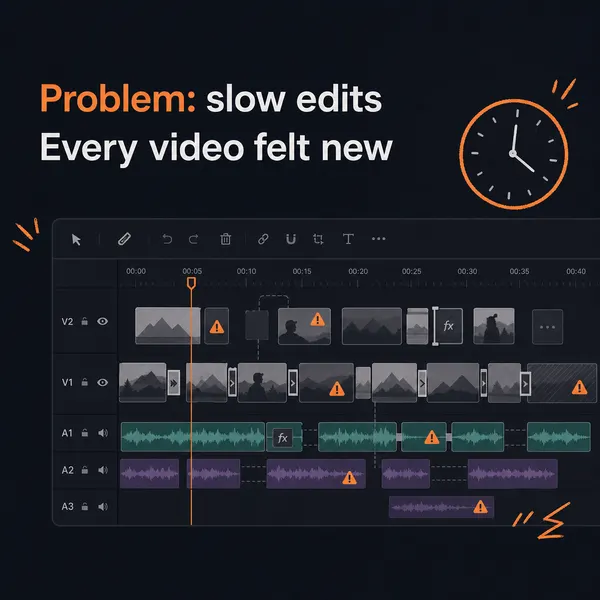
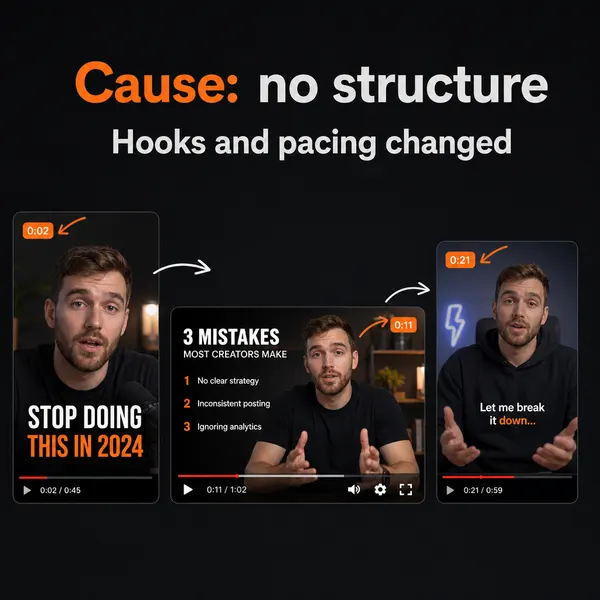
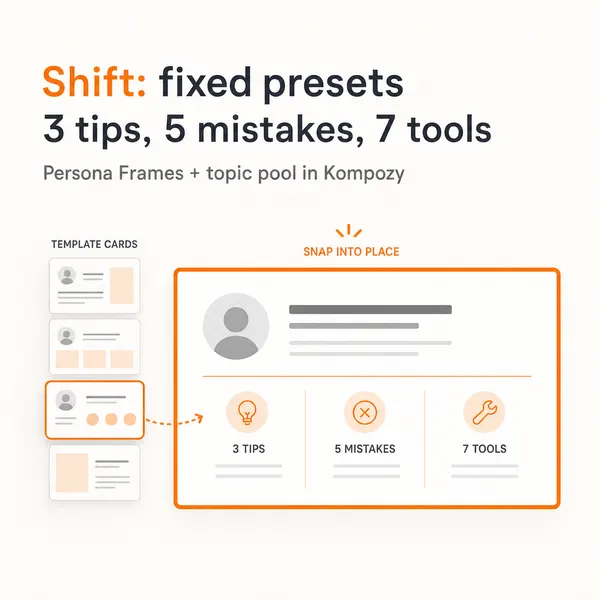
A real carousel made in the Kompozy workspace, shown as an example of the format. It was not made for this guide or for any customer.
Who is this for, and who should skip it?
Best for:
- Local businesses and service firms that field the same buyer questions every week.
- Sites whose FAQ answers can state real prices, times, areas or processes.
- Anyone willing to re-test their questions in the engines on a schedule.
Not ideal for:
- Anyone still building an FAQ page to win a Google rich snippet. That feature is gone.
- Pages that pad the list with near-duplicate questions.
- Teams expecting Kompozy to add schema to their own site or manage their Google Business Profile. It does neither.
Frequently asked questions
Do FAQ pages still help now that Google removed FAQ rich results?
Yes, but the value moved. The visible SERP feature ended on May 7, 2026, so FAQ pages no longer earn a rich snippet. What they still do well is get cited by AI answer engines, because a question paired with a standalone answer is exactly the passage ChatGPT, Perplexity, Gemini, and Google's AI Mode extract. Google also still parses FAQPage markup to understand the page. Build the FAQ for AI citation and on-page clarity, not for a rich result.
Should I keep or remove FAQPage schema after May 2026?
Keep it. FAQPage remains a valid Schema.org type, Google continues to parse it to understand your page, and it gives machines an explicit question-to-answer structure. Google has said the markup will not cause problems even though it no longer produces a rich result, so there is no benefit to stripping it — and doing so removes a machine-readability signal for AI answer engines.
How many questions should an FAQ page have?
Enough to cover the distinct questions people actually ask, and no more. A focused set of precise, exactly-phrased questions earns citations; padding past that with near-duplicates adds no lift and dilutes the page. Prioritize specificity — several sharp questions with standalone answers outperform a long list of broad, overlapping ones.
How long should each FAQ answer be?
Lead with a short, direct answer that fully resolves the question on its own, then add supporting detail below for the human reader. The front-loaded block is what an engine lifts, so it has to stand alone without relying on the question or the surrounding page. Longer context underneath is fine for readers and does not hurt extraction as long as the opening answer is self-contained.
Is one big FAQ page better than FAQs on each relevant page?
For AI citation, a short FAQ block placed on the specific service, product, or topic page it relates to usually matches prompts better than a single catch-all FAQ page, because the answer sits in context with the rest of that topic. A dedicated FAQ page still works if each answer is standalone. Many businesses do both: contextual FAQs on key pages plus a central FAQ page for the broad questions.
How do we know this?
On 2026-10-23 we checked the FAQ rich result history against Google's 2023 announcement, Google's FAQPage documentation and TechWyse's report of the May 7, 2026 notice. We removed unsourced answer-length and question-count figures and an example price. Kompozy plan details come from kompozy.io/pricing.
Sources
- Google Search Central Blog: Changes to HowTo and FAQ rich results (Aug 2023) (read 2026-10-23)
- Google Search Central: FAQ (FAQPage) structured data (read 2026-10-23)
- TechWyse: Google ends FAQ rich results for all sites (May 2026) (read 2026-10-23)
- Kompozy: Pricing (read 2026-10-23)