Social-first content distribution in 2026: what it means to publish natively, not just everywhere
A social-first distribution model treats the platform feed as the destination, not a road to your website — and it draws a hard line that most teams still cross: publishing natively is not the same as posting everywhere. Mirroring one file to six apps is cheap and it is exactly what the algorithms now punish, because Instagram has said it does not recommend Reels carrying logos from other apps. This guide defines social-first as an operating model, explains the difference between native publishing and cross-posting, walks the pillar-to-native-atoms workflow that makes it work, and confronts the reason teams keep mirroring despite the penalty: producing a genuinely native version for each surface costs far more than reshaping one asset, and that native tax — not the strategy — is what decides whether a social-first plan survives contact with a real week.
Published 2026-09-08 · Updated
Short answer
Social-first content distribution treats each platform's feed as the destination and publishes a native version of an idea into it, instead of posting links back to a website or mirroring one file everywhere. Rebuild one pillar idea into vertical clips, carousels, threads and email. Instagram has said it tries not to recommend Reels carrying other apps' logos, so a watermarked cross-post gives up reach.
Key takeaways
- In a social-first model the feed is the destination, not a road back to your site.
- Cross-posting copies one file; social-first rebuilds one idea for each surface.
- Instagram has said it tries not to recommend Reels with logos from other apps.
- Start from a pillar, break it into native pieces, then publish each one in that platform's format.
- Measure per platform with in-feed metrics, not blended website traffic.
What does "social-first" change?
Social-first is often described as a channel priority — "post on social before you post on your blog" — which undersells it. What it actually changes is the destination. In the older model, social was a road: you made the real thing (a blog post, a landing page, a webinar recording) and used social posts to drive people back to it. Social-first inverts that. The feed itself is the destination. The thing you publish natively into TikTok, Instagram, or LinkedIn is not an advertisement for the content — it is the content, consumed in full without leaving the app. That single reframe is what forces every other decision on this page.
The reason this stopped being a preference and became the default is that discovery moved. Social platforms have become a primary place people find new brands and products, rivaling or surpassing search for that job, and younger audiences increasingly treat social as their search engine. When the top of the funnel is a feed, the content that wins is the content built for the feed — not a link that asks someone to interrupt their scroll, tap out to a slow-loading page, and pick up where the algorithm left off. If discovery happens on the platform, the content has to live on the platform. This guide is the execution companion to the broader content distribution strategy framework, which maps the owned, earned, and paid channels a plan travels through; here the focus is narrower — how you produce and publish inside the social channels once you have decided to lead with them.
Why publish natively instead of everywhere?
The phrase "publish everywhere" is where most social-first plans quietly go wrong, because there are two ways to be everywhere and they produce opposite results. One is to take a finished asset and mirror it, unchanged, to every platform — the same landscape video, the same caption, the same link — which is fast, cheap, and exactly what the platforms are built to bury. The other is to take one idea and rebuild it natively for each surface, which is slow, expensive, and exactly what earns reach. Social-first means the second one. "Native, not everywhere" is the rule, and it has teeth.
The recycled-content penalty is real, and platforms say so out loud
This is not a folk theory about the algorithm. Instagram told creators in 2021 not to post content visibly recycled from other apps, and in 2024 Adam Mosseri said Instagram tries not to recommend Reels with logos from other apps. The video stays live and visible to followers, but it is not pushed to new people. A cross-post carrying another app's watermark gives up the recommendation reach a clean, native upload can still earn. The practical read is blunt — mirroring is not merely less effective than native publishing, it is actively suppressed, so the cheap path and the penalized path are the same path.
The feed rewards content that keeps people in the feed
Underneath the watermark policy is a simpler incentive. Every platform's recommendation system optimizes for keeping people watching or reading inside the app, so it favors formats that do that: a video posted natively over a link that sends people away, a carousel that gets swiped over a static image with a URL in the caption, a thread that unfolds in place over a "read more on our site." Native publishing aligns your content with the one thing the algorithm is actually trying to maximize. That is why the destination shift and the reach mechanics are the same fact seen from two sides — the feed is the destination because the feed rewards being the destination.
How do you run a social-first model without drowning?
The workflow that makes social-first sustainable is not "make more content." It is a specific sequence that starts from one idea and ends with a native version living in each feed you have chosen. Three moves define it.
Start from a pillar, not a platform
Begin with one substantial idea — a pillar. A recorded talk, a customer story, a strong point of view, a product walkthrough. The pillar is the source of truth for a batch of content; it is not itself the thing you distribute. Starting from a pillar rather than from "what should I post on LinkedIn today" is what keeps a week of native posts coherent instead of scattered, because every atom traces back to the same core idea and reinforces it. This is the same logic behind scaling social media content as a repeatable production system rather than a daily scramble.
Atomize the pillar into native atoms
Break the pillar into the smallest useful units and rebuild each one in the native shape of its target surface. A single talk becomes vertical clips for TikTok, Reels, and Shorts; a carousel that walks through the argument for Instagram and LinkedIn; a text thread for X; a quote graphic for the feed; a still-photo post; an email highlight for the owned channel; and the full recording on YouTube. The word that matters is rebuild, not resize. A native atom is written and framed for its surface — vertical, captioned, hook in the first second, no foreign watermark — not the same file exported at a different aspect ratio. Short-form clips deserve special weight here, because a short clip is often how people first find long-form content; the clip is the front door, and the long piece is the room behind it.
Publish into each platform's own format and cadence
Publishing natively is the last mile and the one teams skip when the week runs short. It means uploading each atom directly into its platform in that platform's native format — not scheduling one link that fans out identically, and not dropping a watermarked re-export. It also means respecting that each surface has its own rhythm: what reads as consistent on X is noise on LinkedIn, and a cadence that feeds TikTok will starve a newsletter. A social media calendar is the instrument that keeps per-surface cadence honest, and cross-posting on social media covers the harder judgment calls — when a light adaptation is enough and when an atom genuinely has to be rebuilt from scratch.
How do you measure a social-first plan?
Social-first breaks the old measurement habit of reporting one blended traffic number, because the whole point is that people are consuming in the feed and never arriving at your site to be counted. If you grade a social-first program by website sessions, you will conclude it is failing while it is working. The metrics that matter are native: reach and saves per surface, follower and subscriber growth, watch-through and completion rate on video, shares and replies — the in-feed engagement that signals the algorithm to keep distributing you. Measure per platform, never blended, because distribution fails unevenly and one surface is usually carrying the result while another is pure effort. For the harder problem of reconciling numbers that never line up across platforms, see cross-platform campaign measurement.
What is the native tax in social-first distribution?
Mirroring one asset to six platforms takes minutes. Rebuilding one idea into six genuinely native atoms — each written for its surface, framed correctly, captioned, on brand, clean of any foreign watermark — takes most of a day, every time. That gap is the native tax, and it is why teams keep mirroring even though they know it is penalized: the penalized path is the one they can actually afford at cadence. A social-first plan does not usually fail because the strategy was wrong. It fails because the team could produce two native atoms before the week ran out, so four surfaces got a recycled export or nothing, and the "social-first" program collapsed back into a blog post and a link. Breadth of native distribution is bounded by how fast you can produce native, not reshaped, content. Solve that and the model runs; leave it unsolved and the model is a wish.
Where does Kompozy fit in social-first distribution?
Kompozy does not decide your pillars, pick your platforms, or write your positioning — the social-first strategy on this page is yours to set. What Kompozy attacks is the native tax, the one constraint that decides whether the plan is executable, and it does it at both ends the tax lives: generation and publishing. It is an AI content generation and multi-platform publishing engine, and the difference from a scheduler is that it does not reshape one file — it generates the surface-shaped format for each destination from the start.
On the generation side, point it at one pillar and it produces the native atoms directly rather than handing you one asset to resize by hand. Vertical Persona Shorts and Clipped Shorts with burned-in captions for TikTok, Reels, and Shorts; Carousel Posts built brand-exact through HyperFrames for Instagram and LinkedIn; Photo Posts, Quote Graphics, and Infographic Photos for the feed; Text Posts and threads; a long-form Blog Article; and an Email Newsletter for the owned channel — up to 20 output formats from a single input, each generated in the shape its surface rewards. Because every atom is generated fresh and clean for its target, none of it carries a rival platform's watermark or reads as recycled, which is the exact signature that triggers the reach penalty. A face-locked persona pool and one Persona Brief keep a dozen native versions recognizably the same brand instead of drifting apart as volume climbs.
On the publishing side it closes the last mile the model depends on. The same engine publishes each atom into its platform natively — a direct upload in each feed's format across 9 social platforms plus blog and email — rather than fanning one link everywhere, so what lands in each feed is the native artifact the algorithm favors, not a link post or a re-export. Autopilot and a per-post review gate keep per-surface cadence running as a standing program instead of a manual push you drive every week. The strategic half stays with you; the native tax — producing genuinely native content and getting it into each feed clean — is the half the engine pays down, which is what turns a social-first plan from something you can describe into something you can actually sustain.
What makes a social-first distribution plan work?
Social-first is not "post on social first" — it is treating each platform's feed as the destination and publishing the native version of an idea directly into it. The discipline that separates a working social-first plan from a mirrored mess is native, not everywhere: rebuild one idea into the format each surface rewards, because Instagram openly declines to recommend Reels carrying other apps' logos, and a clean native upload keeps the reach a watermarked cross-post gives up. The workflow is pillar, native atoms, native publishing, per-surface measurement. And the constraint that decides whether any of it happens is the native tax — the cost of producing truly native versions at cadence. Get the model right, then pay down the tax, because the tax is what the model actually runs on.
What does this look like in Kompozy?
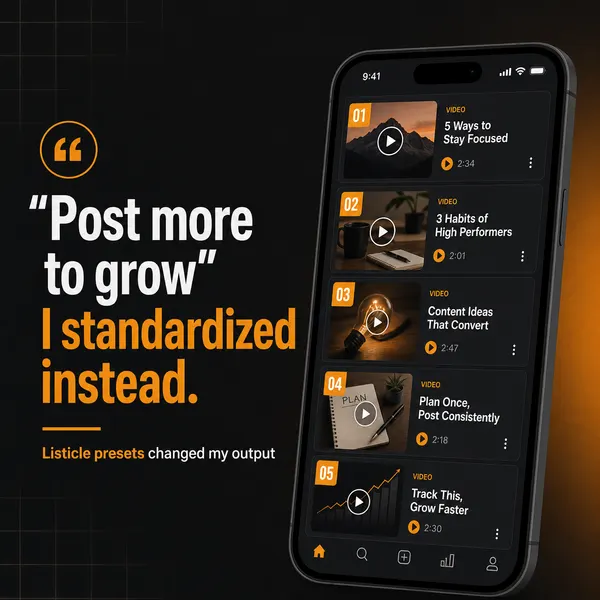
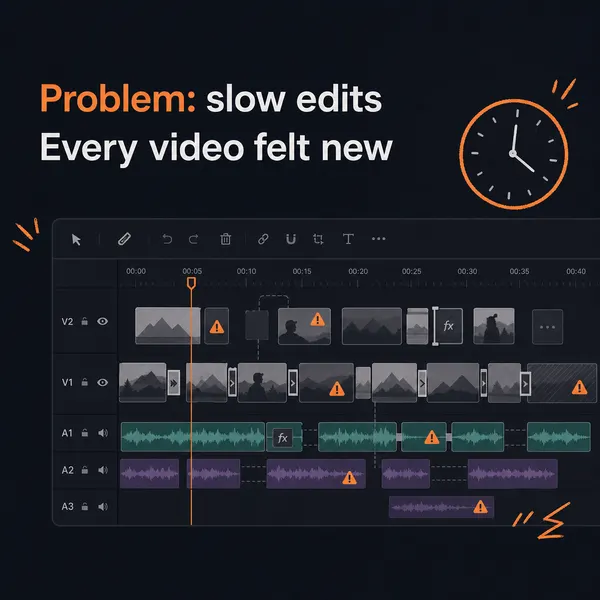
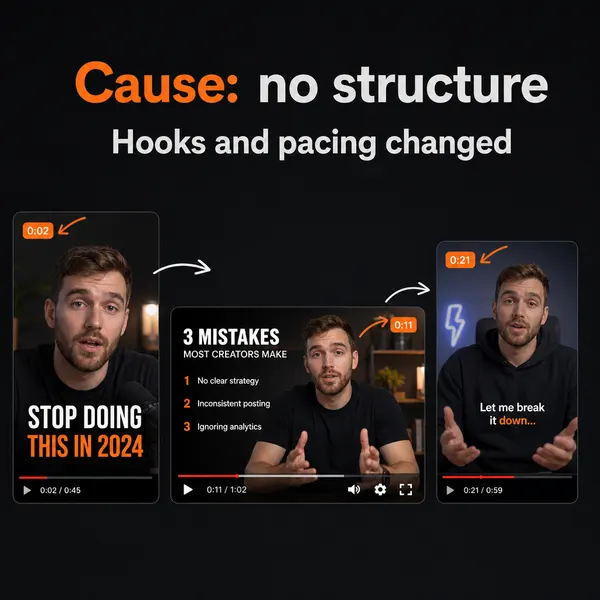
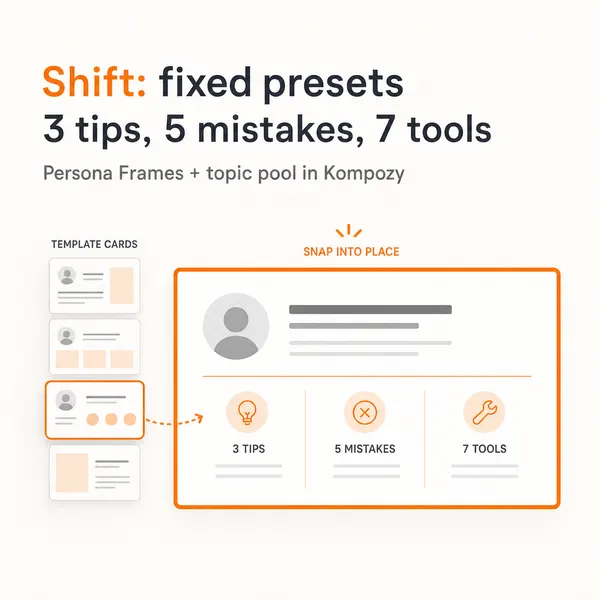
A real five-slide carousel from the Kompozy workspace. It shows one of the native formats a single pillar idea can become.
Who is this for, and who should skip it?
Best for:
- Brands whose audience finds them in feeds rather than through search
- Teams cross-posting one watermarked file to several apps
- Anyone with a strong long-form source to break into pieces
Not ideal for:
- Businesses whose revenue depends on site visits from search, where links still matter more
- Teams that can only sustain one platform well
- Anyone wanting software to set the strategy; picking pillars and platforms stays with you
Frequently asked questions
What is a social-first content distribution strategy?
It is a distribution model that treats social platforms as the primary place discovery happens and builds everything around their native feeds, rather than treating social as a place to drop links back to your website. In practice it means the social-native version of an idea is the main artifact — a set of vertical clips, a carousel, a thread — each shaped for how people consume on that specific surface, with the long-form piece supporting it rather than being the destination you are trying to drive people to.
What does it mean to publish content natively?
Native publishing means uploading a piece in the format and behavior a platform expects and rewards — a vertical video posted directly to TikTok, a carousel built inside Instagram, a thread written as a thread — rather than posting a link out to the same content hosted elsewhere or mirroring one identical file to every app. Native content keeps people on the platform, which is what the algorithm optimizes for, so it consistently earns more reach than a link post or an obviously recycled upload.
Is social-first the same as cross-posting?
No, and conflating them is the most expensive mistake in the model. Cross-posting takes one finished asset and mirrors it to every platform unchanged. Social-first takes one idea and rebuilds it natively for each surface. The distinction matters because Instagram has said it does not recommend Reels carrying another app's logo or watermark, so mirroring is not just less effective, it is penalized. Native adaptation is the whole point of going social-first.
Does recycled or watermarked content really get less reach?
On Instagram, yes. Instagram advised creators in 2021 not to post content visibly recycled from other apps, and Adam Mosseri said in 2024 that Instagram tries not to recommend Reels with logos from other apps, though your own logo is fine. The video stays live and visible to followers but is not pushed to new viewers. This is why a clean, natively uploaded version reliably outperforms the same clip cross-posted with another app's watermark stamped on it.
How is social-first different from an owned, earned, and paid strategy?
They operate at different levels. Owned/earned/paid is the channel-ownership map for any distribution plan — where a piece travels and who controls each surface. Social-first is a stance on how you produce and publish inside those channels: make the platform-native version the primary artifact and publish it into each feed the way that feed rewards. You use both together. The broader channel framework is covered in the content distribution strategy guide; this page is about executing the social-native half of it well.
How do we know this?
We checked every figure and named fact on this page against the sources listed below on 2026-10-23, and removed or rewrote anything we could not confirm. The recycled-content claim comes from Social Media Today's report on Adam Mosseri's 2024 comments and Instagram's 2021 guidance. Kompozy product details come from kompozy.io.
Sources
- Social Media Today — Instagram clarifies that including your own logo on a Reel is OK (read 2026-10-23)
- Kompozy — homepage (formats, 9 platforms, review gate) (read 2026-10-23)
Get started → · ← All guides · Compare Kompozy vs other tools