How to check if AI search is citing your content (2026)
Check whether AI search cites you: run your real buyer prompts through ChatGPT, Perplexity, Gemini, and Google AI, log who's cited, then track it on a cadence.
Last verified · 2026-10-23 · by Moe Ameen
Published 2026-09-10 · Updated
Short answer
To check whether AI search cites your content, list the questions your buyers actually ask and run each one through ChatGPT, Perplexity, Gemini and Google's AI answers in a clean, logged-out session. For every prompt, log whether you're cited with a link, how you're described, and who is cited instead. Add Search Console's AI report for Google, and re-test monthly.
Key takeaways
- Test real buyer questions, not your target keywords.
- Use a clean, logged-out session so your own history doesn't skew the answer.
- Log three things per prompt: cited or not, how you're described, and who won instead.
- Search Console's generative AI report shows impressions only, with no clicks or queries.
- AI answers vary run to run, so read the trend across months.
Before you spend a quarter trying to earn AI citations, find out where you stand right now — because "are we cited?" is a question you can answer today with the engines themselves, and the answer tells you exactly what to fix.
An AI citation is the source an answer engine links under a claim in its response; being cited is how your content gets read, quoted, and eventually recommended when the searcher is talking to ChatGPT, Perplexity, Gemini, or Google's AI answers instead of scrolling a results page. The problem is that most teams guess at their AI visibility, or they check once, see themselves mentioned, and assume they're fine. Neither is a measurement.
This is the practical, do-it-today version: build the list of prompts your customers actually ask, run them through each engine under clean conditions, and log three things per prompt — whether you're cited, how you're described, and who is cited instead of you.
That last column is the useful one, because every miss is a diagnosable gap: no content for the query, no presence on the surface the engine pulled from, or a weaker passage than the competitor who won the slot. Then you track it on a cadence, because retrieval is live and today's result is not next month's.
To understand the mechanics behind what you're measuring, read the companion explainer on how AI search selects and cites sources; to act on the gaps once you find them, pair this with how to win citations in AI answers.
How do you check if AI search is citing your content?
- Write the prompts your customers actually ask. Start from demand, not vanity. List the real questions a buyer or researcher would type into an answer engine on your topic — the informational ones ("how does X work"), the comparative ones ("best X for a small team"), and the decision ones ("is X worth it for Y"). Pull the phrasings from your sales and support inbox, from autocomplete, and from typing your own buying questions into ChatGPT. These prompts, not your target keywords, are the exact things you're checking whether you're cited for.
- Run each prompt through every major engine. Test the same prompt list in ChatGPT, Perplexity, Gemini, and Google's AI answers (AI Overviews and AI Mode), because their source preferences can differ, and a page cited in one can be missing from another. Where the engine has a search or web mode, use it, since that's the retrieval path that produces citations. Run each prompt in a clean, logged-out session so your own history doesn't personalize the result into something no one else sees.
- Log three columns per prompt: cited, how described, who instead. For every prompt, record whether your domain appears as a cited source (a linked citation, not just your name in prose), how the engine describes you when it does, and — critically — which sources it cited instead. A simple sheet with prompt, engine, cited yes/no, your description, and competing sources is enough. The "who instead" column is where the strategy comes from: it names the pages and surfaces currently winning the slot you want.
- Separate being cited from being mentioned and being recommended. These are three different outcomes and they need different fixes. A citation is a linked source backing a claim. A mention is your name appearing in the prose with no link — visibility without attribution. A recommendation is the engine naming you as the answer to a "which should I use" query. You can be mentioned but not cited, or cited as a source but not recommended as an option, so track them as separate states rather than collapsing them into one "are we there" checkbox.
- Cross-check surface presence in Google Search Console. Google's dedicated generative AI performance report in Search Console shows how often your pages appear inside AI Overviews, AI Mode, and Discover's AI features — but it's impressions only, with no clicks, CTR, position, or query data yet, so it shows surface-level presence rather than per-prompt citation. Use it as the aggregate companion to your manual prompt testing: it tells you whether Google's AI answers are surfacing your pages at all, and roughly how often. The full setup is in how to set up AI search performance reporting in Search Console.
- Add a tracking tool once you go past a handful of prompts. Manual testing is the right way to start and to sanity-check, but it doesn't scale past a small prompt set or run on a schedule. Once you're serious, a dedicated AI-visibility or citation-tracking tool will run your prompt list across engines on a cadence and log share of voice, citation rate, and which sources win. Treat the tool as the way you monitor at volume, and keep doing occasional manual spot-checks, because tools abstract away the exact wording of the answer that manual reading catches.
- Diagnose each miss into one of three gaps. Every prompt you lose falls into one of three buckets, and the fix differs. No content: you have nothing that answers this query — you need to make it. Wrong surface: a competitor was cited from Reddit, YouTube, or LinkedIn, so the gap is presence on that surface, not another blog post. Weaker passage: you have a page but a competitor's answer is more specific, self-contained, or trusted — you need to sharpen the passage. Tag each miss so your production work is aimed, not scattered.
- Re-test on a cadence and watch the trend. One check is a snapshot, not a signal — AI answers are non-deterministic and retrieval is live, so a single run can mislead in both directions. Re-run your prompt list on a set cadence (monthly is a sensible floor), keep the history, and read the trend: which prompts you started winning after you shipped content, which you lost, and where a competitor moved in. The trend line, not any one answer, is what tells you whether your AI-citation work is actually landing.
What mistakes skew an AI citation check?
- AI answers are non-deterministic and personalized — the same prompt gives different results across runs, accounts, and regions. One check proves nothing; test multiple times in a clean, logged-out session and read the pattern.
- A name in the prose is not a citation. Being mentioned without a linked source is visibility without attribution — track mentions and citations as separate states, not one.
- Citation and recommendation are different jobs. You can be cited as a source and still not be the brand the engine recommends; measuring only one hides the gap in the other.
- Search Console's generative AI report is impressions only — no clicks, CTR, position, or query data — so it shows surface presence, not which prompt cited which page. Use it alongside manual prompt testing, not instead of it.
- Checking only ChatGPT is a blind spot. Engines can cite different sources, so a page invisible in ChatGPT may be cited in Perplexity or Google's AI answers, and vice versa — test all of them.
- A competitor cited from a community or video source means your gap is a missing surface, not a weaker blog post. Don't answer a surface gap by writing another article.
Where does Kompozy fit after an AI citation audit?
Checking is only half a loop — the value of an AI-citation audit is what you do with the "who's cited instead" column, and that's where the work turns from measurement into production. Each miss you tagged in step seven is an assignment: a query with no content to make, a surface where a competitor won so you need presence there, or a passage to sharpen. Kompozy is what closes that loop fast.
It's an AI content generation and multi-platform publishing engine, not a tracking tool — so the workflow is: audit in the engines, produce the missing piece in Kompozy, publish it to the surface that lost the slot, then re-test on your next cadence to see if the gap closed.
The fit is that the gaps an audit surfaces almost never map to one format, and Kompozy produces the full range from one idea. A "no content" miss on an informational query becomes a citable Blog Article and Text Posts written as self-contained, specific passages.
A "wrong surface" miss — a rival cited from a video result — becomes a talking-head Persona Short or a clipped vertical for YouTube and the feeds, because a blog post can't fill a video gap. A comparison you keep losing becomes a brand-exact Carousel and Quote Graphics.
Every output is governed by one Persona Brief that pins your voice and terminology, which also keeps your brand described consistently across surfaces — the corroboration engines reward when they weigh whether to trust and cite a claim about you.
Autopilot then fans that targeted set across the 9 platforms Kompozy supports behind a per-post review gate, so the surface presence your audit said was missing actually gets built and maintained between checks.
Be clear on the boundary: Kompozy doesn't run the audit, it doesn't post to Reddit or write your Wikipedia entry, and it can't force an engine to cite you — the citation is earned by the passage and by third-party discussion you don't control. What it removes is the slow part of the loop: the throughput gap between finding a citation you're losing and shipping the content that competes for it.
Starter ($199/mo for 5,500 credits, 4 platforms) fits a solo operator closing gaps on one brand; Pro ($499/mo for 18,000 credits, 9 platforms and full autopilot) fits a team producing across many prompts and surfaces each cycle; Enterprise is available through Contact Sales for agencies auditing and filling gaps across many brands.
What does this look like in Kompozy?
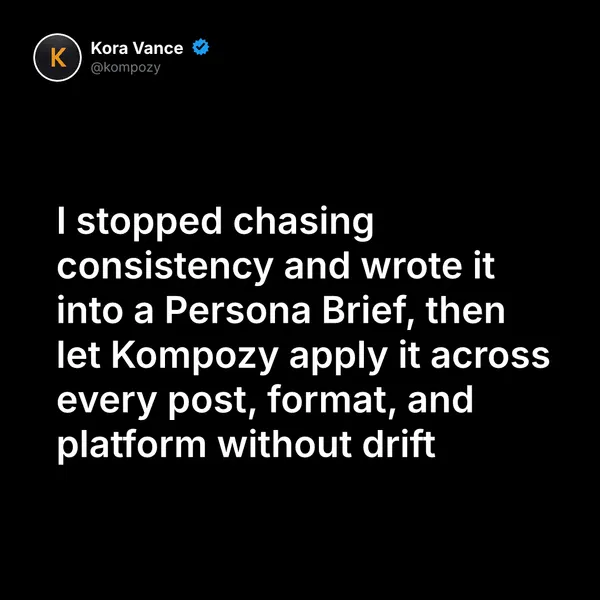
A real quote graphic from the Kompozy workspace, the kind of asset that can fill a gap an audit turns up. We're not claiming it earned any citation.
Who is this for, and who should skip it?
Best for:
- Brands that have never measured whether AI answers mention them.
- Marketers about to invest in AI-search content who need a baseline.
- Teams with a short list of high-value buyer questions.
Not ideal for:
- Tracking hundreds of prompts by hand. Use a tracking tool at that scale.
- Treating one run as proof. Answers change between runs and accounts.
Frequently asked questions
How do I know if ChatGPT or Perplexity is citing my website?
Run the real questions your customers ask through each engine in a clean, logged-out session with web/search mode on, and look at the sources it links. If your domain appears as a linked citation under a claim, you're cited; if your name shows only in the prose with no link, you're mentioned but not cited. Test the same prompts across ChatGPT, Perplexity, Gemini, and Google's AI answers, because their source preferences differ and being cited in one does not mean being cited in the others.
Can I track AI citations in Google Search Console?
Partly. Search Console's dedicated generative AI performance report shows impressions for your pages inside AI Overviews and AI Mode, but it's impressions only — no clicks, CTR, position, or query-level data — so it shows aggregate surface presence rather than which prompt cited which page. It's a useful companion to manual prompt testing for Google's own surfaces, but it tells you nothing about ChatGPT or Perplexity — those you have to check directly or with a dedicated AI-visibility tool.
How often should I check my AI citations?
At least monthly, because AI retrieval is live and answers change as sources are published, updated, and re-ranked. Manual prompt testing works for a small, high-value prompt set on a monthly cadence; if you're tracking dozens of prompts across several engines, a dedicated tracking tool that runs the list on a schedule is more reliable. The point of the cadence is the trend — one snapshot is noisy because AI answers are non-deterministic, so you read the direction over time, not any single result.
What does it mean if I'm mentioned by AI but not cited?
It means the engine knows about you but didn't attribute a claim to your page — your name is in the answer's prose without a linked source. That's real visibility, but it's fragile and it sends no click. Usually it signals that the engine learned about you from third-party discussion rather than from a strong, retrievable passage on your own site. The fix is publishing self-contained, specific content the engine can quote and attribute directly, so the mention becomes a citation.
Why am I cited in one AI engine but not another?
Because engines select sources differently: each runs its own retrieval, over its own index, with its own preferences. A page perfectly shaped for one engine's retrieval can be invisible to another's. That's why you check all of them and diagnose misses by surface, then build presence on the surfaces the engine that's ignoring you actually reaches for.
How do we know this?
We checked what this page says about Search Console's generative AI report against the sources listed below on 2026-10-23, and rewrote or removed any figure we couldn't confirm there. Kompozy plan details come from kompozy.io/pricing.
Sources
- Google Search Console Help — Generative AI performance report (Search) (read 2026-10-23)
- Kompozy — Pricing (read 2026-10-23)
Related tutorials
- How to win citations in AI answers (2026)
- How to get your content cited by ChatGPT (2026)
- How to run a GEO content audit (2026)
- How to set up AI search performance reporting in Google Search Console (2026)
- How to find the sources shaping AI answers in your industry (2026)
- How to check if Google AI Mode is answering your queries (2026)