Instagram's Adam Mosseri Warns Against Removing the Algorithm as Australia Pushes a Chronological-Feed Opt-Out
Days after Australia proposed forcing platforms to let users switch off algorithmic ranking, Instagram's head argued that a feed without ranking gets overrun by high-frequency posters and quietly buries friends and creators.
2026-09-12 · by Moe Ameen
Published 2026-09-12 · Updated
Short answer
Instagram head Adam Mosseri warned on September 10, 2026 that removing ranking would make feeds worse. Without it, he said, the feed "gets overrun with content from accounts that post the most often," burying friends and creators. He was answering Australia's "My Feed, My Way" proposal from September 8, which would let users over 16 opt out of algorithmic feeds. ABC News reported fines of up to $100 million.
Key takeaways
- Mosseri said chronological feeds get "overrun" by businesses and publishers that post most often.
- Australia's My Feed, My Way plan would let over-16s opt out of ranked feeds; under-16s lose infinite scroll by default.
- Instagram's existing Following feed sees low single-digit uptake, per Mosseri.
- The EU already requires a chronological option, and a 2025 Dutch ruling went further.
- Spread your reach across platforms and build email and a blog that no feed law can touch.
What did Mosseri say about Australia's chronological feed proposal?
Instagram head Adam Mosseri argued on September 10, 2026 that stripping ranking algorithms out of social feeds would make the experience worse for most people, not better. The comments came two days after the Australian government released draft "Digital Duty of Care" legislation whose "My Feed, My Way" provision would require platforms to give users over 16 an easy way to opt out of algorithmically curated feeds and see a chronological feed of the accounts they follow instead.
Mosseri's core claim was mechanical rather than defensive. Without ranking, he said, "the feed for the consumer gets overrun with content from accounts that post the most often" — which in practice means businesses, news publishers, and high-frequency posters, because they post far more than a typical friend or individual creator.
He described the result as Instagram moving "to a much less friend-oriented place and a much less creator-oriented place, and towards a much more business, news publisher-oriented place," and said engagement could fall sharply if users are pushed onto chronological feeds. He characterized the people who want chronological feeds as a minority, and predicted that people who switched would end up regretting it.
The Australian proposal, released September 8, 2026 as part of a broader Digital Duty of Care regime, would make platforms notify users of the feed choice, with a separate provision turning off infinite scroll by default for users under 16. ABC News reported fines of up to $100 million for non-compliance.
Two pieces of context matter. Instagram already offers a "Following" chronological feed globally, but uptake is low — Mosseri put it at the low single-digit percentages — because most users never change the default. And Australia is not alone: the EU's Digital Services Act (2023) already requires a non-profiling feed option, and in October 2025 a Dutch court went further, ordering platforms to provide chronological feeds as a default. Treat the fine figure and timeline as reported at the announcement window and confirm against the primary sources, as draft legislation shifts.
Why does a chronological feed opt-out matter for creators?
- This is a debate about the distribution model creators depend on. Most reach for a growing account comes from recommendations to non-followers; a widespread switch to chronological feeds would shrink that unconnected-reach engine and hand distribution to whoever posts most often.
- If opt-outs become law market by market, your reach becomes partly a function of local regulation, not just your content — a reason to reduce dependence on any single algorithmic feed rather than optimize one to the exclusion of everything else.
- Mosseri's own framing is a strategy tell: in a chronological world, the people who chose to follow you (connected reach) are worth far more, so being an account users deliberately follow and forward beats chasing anonymous algorithmic virality.
- Owned channels are the part no feed-opt-out law can throttle. An email list and a blog reach the audience directly and chronologically by nature, which is exactly why they are the durable hedge against platform ranking changes.
- Uptake has been low when chronological is opt-in, but a mandated notification prompting every user to choose could change that materially — so the risk to recommendation-driven reach is real, not theoretical.
How do you protect your reach from feed changes with Kompozy?
The honest read for creators is that this fight is about your distribution, and the safest response is to stop being a hostage to any one platform's ranking — whether it stays algorithmic or gets a legislated off-switch. Kompozy is built to spread a single idea across surfaces so no one feed decides your week. Bring in a source and it generates the whole set from one Persona Brief — Clipped Shorts, avatar Persona Shorts, carousel posts, and short text — then Autopilot schedules and publishes the batch across the eight social platforms behind a per-post review gate. A chronological switch flipping on TikTok or Instagram in one market cannot zero an account that also lands on YouTube, LinkedIn, X, Pinterest, and Threads from the same pipeline.
The part that no opt-out law touches is the owned audience, and it is where Kompozy's breadth matters most here. From the same brief it also drafts an email newsletter to Mailchimp and a blog article to your site — channels that reach the people who chose you, in the order you send them, with no ranking layer in between. That is the structural hedge Mosseri's warning implies: keep winning recommendation reach while it exists, but build a followed, forwardable relationship and an owned list underneath it, so a policy note in Canberra or Brussels changes a slice of your reach instead of all of it. Kompozy does not manufacture engagement; it removes the production ceiling that stops most creators from feeding every surface — algorithmic and owned — at once.
What are the quick takeaways?
- On September 10, 2026, Instagram head Adam Mosseri warned that removing ranking algorithms would make feeds worse — overrun by high-frequency business and publisher accounts, with friends and creators buried.
- The comments answered Australia's "My Feed, My Way" proposal (released Sept 8, 2026), which would force platforms to let users over 16 opt out of algorithmic feeds and respect that choice.
- Mosseri called the people who want chronological feeds a minority and said engagement would drop sharply if users switched.
- The EU (2023) already requires a non-profiling feed option, and an October 2025 Dutch ruling ordered chronological feeds as a default; Instagram's existing "Following" feed sees only low-single-digit uptake.
- The creator takeaway: diversify across platforms and build owned channels (email, blog) that no feed-opt-out law can throttle, rather than betting everything on one algorithmic feed.
What does this look like in Kompozy?
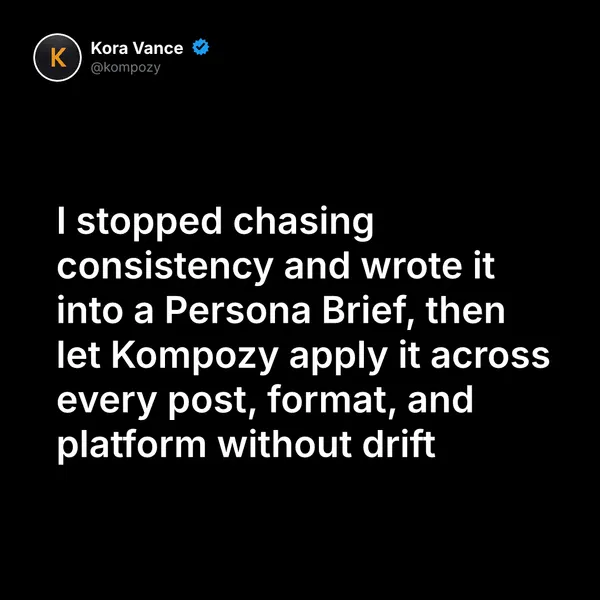
A real quote graphic from the Kompozy workspace. It shows a format you can send to followers, email subscribers and blog readers alike.
Who is this for, and who should skip it?
Best for:
- Creators who rely on Instagram recommendations to reach new people
- Australian brands and creators watching the bill
- Anyone deciding whether to build an email list or blog alongside social
Not ideal for:
- Readers wanting final legal text, since this is still a draft proposal
- Accounts that grow mainly from existing followers, who lose less in a chronological feed
- Anyone looking for a prediction of how many users would switch
Frequently asked questions
Why does Instagram oppose letting users turn off the algorithm?
Instagram head Adam Mosseri argues that without ranking, the feed gets dominated by whoever posts most often — businesses, news publishers, and high-frequency accounts — which buries friends and individual creators and makes the experience worse for most users. He says engagement would fall sharply, that people who want chronological feeds are a minority, and that people who switch would regret it. Critics counter that engagement-maximizing ranking is exactly what regulators are trying to rein in.
What is Australia's 'My Feed, My Way' proposal?
It is part of Australia's draft Digital Duty of Care legislation, released September 8, 2026. The "My Feed, My Way" provision would require social platforms to give users over 16 an easy way to opt out of algorithmically recommended content and see a chronological feed of accounts they follow instead, notify users of the choice, and respect it. The broader proposal also turns off infinite scroll by default for under-16s, and ABC News reported fines of up to $100 million for non-compliance.
How would a chronological feed affect creators?
A chronological feed removes the recommendation engine that pushes content to non-followers, so unconnected reach — the main growth driver for most accounts — shrinks. Distribution shifts toward whoever posts most frequently. It makes connected reach (people who already chose to follow you) far more valuable, which rewards accounts users deliberately follow and forward, and it raises the value of owned channels like email and a blog that reach an audience directly regardless of any feed algorithm.
Do other countries already require chronological feed options?
Yes. The European Union's Digital Services Act, in force since 2023, requires large platforms to offer a recommendation option that is not based on profiling. In October 2025 a Dutch court went further and ordered platforms to provide chronological feeds as a default. Instagram also offers a global "Following" chronological feed already, though reported uptake is in the low single digits because most users never change the default.
How do we know this?
We checked every figure, date, quote and product claim on this page against the sources listed below on 2026-10-23, and removed or rewrote anything we could not confirm. Mosseri's quotes come from ABC News and 9to5Google; the bill's age provisions come from Android Headlines and the fine, EU and Dutch details from ABC News. Kompozy plan and format details come from kompozy.io.
Sources
- ABC News — Instagram CEO Adam Mosseri warns against algorithm laws (read 2026-10-23)
- 9to5Google — Instagram says a chronological feed is much worse (read 2026-10-23)
- Android Headlines — Mosseri defends algorithm as Australia eyes chronological feed option (read 2026-10-23)
- Kompozy — Pricing and plans (read 2026-10-23)
Related news
- Instagram Head Adam Mosseri Says AI Content Is Here to Stay in Feeds — and Real Creators Get More Valuable
- Instagram Tests Episodic "Series" for Reels and Moves "Your Algorithm" Controls Into the Feed
- Instagram Now Treats the Caption as a Primary Discovery Signal — Not Just the Text Under Your Photo
- Instagram Rolls Out New Ways to Expand Reach and Engagement: Replace Audio, Music-Powered Carousels, and AI Stories Effects